Monday, February 26, 2018

NEDAwareness: What We Want You to Know About Eating Disorders


I've never blogged for NEDAwareness, though this is something that's dear to me and something I post about on Instagram almost every year. Earlier this evening, though, I had the idea to write something for this week, though I wasn't sure what kind of post I'd write. Links to awareness websites and support resources? Personal experiences? For whatever reason, these didn't seem right for this time.

I settled on what we, people living our lives with this disorder, want you, those who are not and have not dealt with these particular struggles, to know about us and our illness.

While I know that some of my ideas are shared by others with eating disorders, I should specify that I didn't give this enough forethought to survey the community. Thus, I really should call this "what I want you to know." I understand that I come from a privileged position in this discussion. I am white, I am female, I became ill as an adolescent, I usually fall on the normal-thinner side of average, and my illness was primarily restrictive. My voice is the voice that we often see from this community. My family had the resources to seek treatment for my disorder. We had insurance that helped pay treatment and medication costs. I lived in an area with several professionals to choose from. My story is SO not everyone's story. There are struggles that come with having this disorder in a different body, in a different socioeconomic status, in just different circumstances. My perspective is not final or representative of everyone's. I encourage you to read the stories of people with eating disorders whose stories do not often get heard. The National Eating Disorders Association has a wonderful Marginalized Voices project which presents the perspectives of those voices often overlooked in the walk towards awareness.

In pursuit of awareness surrounding eating disorders, my hope is to address some of the myths surrounding eating disorders and the people who struggle with them, as well as to possibly talk about some things that may not get talked about as much. Some of these deal with the disorder itself, some of them deal with recovery.


With all of that said, here's what we want you to know.


We're not all women.

We're not all white.

We're not all adolescents.

We're not all rich and spoiled.

We're not all thin.

We're not all straight.

We're not all cisgender.

Eating disorders can affect anyone, at any time.

It's not as simple as "just eat a burger!"

We're not just doing it "for attention" (in my experiences with people I've spoken to, sometimes the intention is just the opposite - to fade away and disappear).

You can't make us recover before we're ready. Pushing or forcing someone into recovery won't work. You might see a decrease in behaviors, but without the full commitment of the person, they're likely using different behaviors and hiding them from you.

Recovery is really hard.

Recovery is not just about weight restoration. This is really really important for those who have lost weight, but reaching a healthy weight is by no means the end.

People don't have to be losing weight to have an eating disorder.

People don't even have to want to lose weight to have an eating disorder.

Not all eating disorders are restrictive (like anorexia, which involves restricting food intake to certain amounts, food groups, times, etc).

Not all eating disorders involve purging (vomiting, laxatives, extreme exercise or fasting to overcompensate for eating, etc).

People with Binge Eating Disorder aren't just lazy, fat, slob, whatever else might be used to describe them. It's a real illness that needs to be treated by a qualified team of professionals.

Don't forget Other Specified Feeding or Eating Disorder (OSFED, formerly EDNOS). This is a diagnosis that might be used to describe individuals who use behaviors that cross diagnoses (ex. restricting along with binging in purging in cycles), or who experience all symptoms of anorexia but are not underweight or do not have amenorrhea. (Read about it here) It might be complicated, but the main point is: it's not just anorexia and bulimia.

It's not about vanity. Most of us couldn't care less about what the world thinks of how we look. We're too concerned with like, having a mental illness.

Just because we think we're fat, doesn't mean we think you're fat.

Please don't belittle us or devalue our feelings and fears. You don't know what it's like to think of dinner and have a full-blown panic attack. You just don't know. This is an illness of the mind that alters normal responses to hunger, food, and fulness. Please respect our feelings and fears, and believe us.

This is SO not about food. It's actually about a lot of other things - depression, stress, societal beauty standards, perfectionism, a hyper-controlled childhood, or a grocery list of other causes.

While eating disorders aren't caused by New York Fashion Week and Victoria's Secret models, a culture obsessed with thinness and dieting does contribute. We live in a culture that is constantly telling us that thin is best, that eating is a reward, that we work out to burn off calories, that we should be dieting and counting calories, that it's good for young people to participate in dieting programs. That thin and fit are more worthy of life and love. Terrible message. When people feel they are unloved, unworthy, undeserving, our culture gives them an easy fix - just lose weight and you'll be happy, you'll be lovable, you'll be loved, you'll be worthy. That's the trick. And that culture is a lie. Dismantling a culture defined by patriarchy, able-bodiedness, white supremacy, heteronormativity, and the like is crucial on the path of a systemic fight to prevent eating disorders.

These are addictions. Just like alcohol, just like cocaine. Some theories propose that people with restrictive eating disorders have an abnormality in the part of the brain that deals with hunger cues and rewards. Usually, humans experience hunger, feed ourselves, and the brain releases chemicals lifting our mood. For people with restrictive eating disorders, the opposite can happen - hunger itself can light up the brain's reward system. So rather than getting hangry, we might feel high. The same can happen after purging. Like an addict looks for the bottle or the drug to lift the mood after a hard day, someone with an eating disorder will look for the behavior that lowers stress and brings a high, whether it's fasting, purging, exercise, or another behavior.

Recovery doesn't happen overnight.

Just because someone is weight restored and behavior-free, that doesn't mean their mind is healed. And since this is an illness of the mind, a behavior-free but ill mind will in time revert to those old behaviors.

Some of our rules about food, fears about food, or practices surrounding food or our bodies might seem weird to you. If it's just "weird" and not dangerous, let it go. We'll work with our treatment team to achieve healing, and you just support us where we're at. Let us be weird while we're healing.

Don't yell, fuss, shame, scold, or the like if we use behaviors. It's not a disciplinary problem, it's a mental one. Instead, ask about what happened to cause the urges, and deal with that.

Talking about how gross vomiting or laxatives is won't stop us from using those behaviors.

Commenting on our weight loss or restrictive eating patterns with envy, cooing about how you "could never do that" is really . . . just don't do it. Don't be jealous of the weight loss. Don't envy the "self-control" people with restrictive eating disorders have. It's just not cool. Eating disorders are so not cool or enviable.

PLEASE don't comment on our body size or how we look. Not that we've gained or lost or "look healthy" - nothing. This can be quite triggering, and there's lots more cool stuff to talk about. "Wow, the weather, huh?!?" (The only exception I can think of is if you know someone in recovery from a restrictive or purging eating disorder who seems to be losing significant weight and isn't in treatment - then you might think about GENTLY voicing your concern.)

We might be real jerks sometimes. We're sorry. We don't want to be jerks and ruin our friendships. Often, we want to do everything except hurt you, and sometimes it seems that our eating disorder is the solution and the way to avoid hurting those we love. We might not really realize how we're hurting you. Or we might feel like this is the only choice we have to deal with whatever is going on in our lives. While I'm totally not encouraging anyone to get stuck in a codependent relationship with no boundaries, I do ask that you give us grace. Keep a distance if necessary, but try to realize that when the ED mind is in control, we're not ourselves and we're not thinking rationally. We're sorry for hurting you.

Please don't give up on us. Even if you're not sure you have hope that we'll ever recover, fake that hope for us. Tell us we can beat this. Remind us what you like about us (but don't lie, that's not cool, either). Tell us that things will get easier. Show us your hope, because we often feel like we have none.

~ ~ ~

If you have experienced an eating disorder, what would you add? What do you want people to know about your eating disorder or recovery?


Click here for more information about National Eating Disorders Awareness Week.

Thursday, February 22, 2018

Prayer: Reflections for Lent - Using a Journal

I am a huge fan of the prayer journal. As I wrote in the intro to this series, a prayer journal was the way I started praying. I am a writer, and it’s much easier for me to write to God (or anyone else) than to have to say words out loud. A pen and a page is my comfort and security. 

Over the years, I’ve used prayer journals in three ways. I’ll write about each of them briefly. 

The first prayer journal I had was simply a collection of prayers. I was raised Methodist, and we prayed the Lord’s Prayer each Sunday in service. 

"Our Father, who art in heaven, hallowed be thy name. Thy kingdom come, thy will be done,      on earth as it is in heaven. Give us this day our daily bread. Forgive us our trespasses      as we forgive those who trespass against us, And lead us not into temptation      but deliver us from evil. For thine is the kingdom,      and the power,           and the glory forever. Amen.

(Sidenote: If you look, you’ll notice that Jesus here uses a PATH or ACTS pattern of prayer. He begins by naming and describing who God is, praise and adoration - Father in heaven, holy are you. Then he goes on to ask for help, or supplicate - thy will be done, give us bread, forgive us, help us forgive others, keep us from sin. We talked about these patterns of prayer in a previous post.)

My first prayer journal included some of my grandmother’s Catholic prayers, too:

Glory be to the Father, and to the Son, and to the Holy Ghost.As it was in the beginning, is now, and ever shall be,World without end. Amen.

Hail Mary, full of grace, the Lord is with thee.Blessed art thou among women,and blessed is the fruit of thy womb, Jesus.Holy Mary, Mother of God,pray for us sinners, now and at the hour of our death. Amen.


Later, I prayed using the Upper Room devotional and I would write the provided prayers as a letter to God in my prayer journal.

If you’re interested in a prayer journal like this, you can find pre-written prayers al over the place. Just google, and you’ll likely find a prayer for every situation you could imagine. 

Another fabulous place to look for pre-written prayers is scripture itself. The book of Psalms is a collection of ancient hymns (ever noticed that the word “psalm” sounds a lot like “song”? Yeah, that’s a linguistic connection). When you don’t know what to pray, the Psalms are an excellent resource for joining yourself with a great legacy of faith. There are also prayers scattered throughout the Book of Mormon and Doctrine & Covenants that you could use verbatim or alter to suit your needs. The Quran also includes many passages of prayer. What’s so great about these is that you’re not praying alone, but joining with thousands of even millions of other people praying just as you are. 

When it came time to pray - morning, evening, lunch, whenever - I would find the prayer that was appropriate. This type of prayer journal was immensely helpful when I didn’t know what to pray. 

~ ~ ~

Once I became somewhat comfortable with the idea of praying, I would use my journal as a place to write personal letters. I’d write my prayers (Dear God, . . . ) but I wrote my own words. I’d sometimes still go for the PATH/ACTS formula. Other times I’d write like I was writing to a friend from summer camp, simply telling God what’s going on in my life, how I was feeling, what I was looking forward to, and asking for help with things. 

I did this during what I would call my strongest period of prayer. This was during my first year in college, when I was investigating the LDS church. I would wake up each morning, get dressed, and walk to the cafeteria. I’d start my time with a short, simple prayer in my mind, thanking God for my food, asking a blessing upon it, and asking for the Holy Ghost to be with me as I read and prayed. Then, I would read as I ate. I always started with a Psalm or Proverb - something to remind me how to pray or how to live. Then, I’d read through a few chapters, usually in the Book of Mormon. After reading and eating, I’d write. I’d thank God for what was going on, I’d pray for help implementing the things I’d learned during my scripture study, and I’d ask a blessing upon my day. I treasured this morning time with God. And I dreaded when anyone wanted to stop by to say hello in the cafeteria! 

If you’re unsure about the whole praying-out-loud thing, I’d recommend writing prayers as a starting point. 

~ ~ ~ 

The final way of using a prayer journal is one I just recently learned about and began utilizing. It’s not better or worse than any of the others, just different. I was inspired to follow this method after hearing from a local preacher and from Alyssa Joy Bethke (married to Jefferson Bethke, whom you might know from this video).

In this way, I have separated sections for each part of prayer. I pray along a sort of PATH/ACTS pattern. I have a page with a list of who God is - merciful, generous, judge, redeemer. Then, I have a list of what God does - You hear my cry, You protect me, You are making me new. Both of these are based on what I read in scripture, hear in songs, and experience in my daily life. Next, I have a (very short) list of things to thank God for. Finally, I have a list of people to pray for by name - my family, friends, coworkers, a child I sponsor through Compassion International. I also have a list of personal requests - things I’m asking God for myself, rather than prayers for others. I ask God to help me love others, to know what to do, to bless my work, and more. 

This is the method I’m using right now. Each morning, I begin my time with a Psalm, one of those ancient prayers that have been spoken to God for thousands of years. Then, I read in the scripture (right now I’m reading through the New Testament, then I’ll go through the Book of Mormon). After that, I have a daily devotional that was given to me - Tozer on the Almighty God. This book has a verse, an excerpt from the writing of Tozer, and a simple prayer (to be honest, I’m not crazy about it, but I’m giving it a go since I received it from a friend). Once I’m done reading, I kneel to pray. I go through my journal, praising God for who God is and what God does, thank God for what God has provided for me, and humbly asking God to bless myself and the people in my life.

~ ~ ~


The prayer journal has been the most important and influential tool for prayer in my life. If you aren’t praying, if you feel like you don’t know how to pray, if you want to start a daily habit of prayer, or if you’re looking for a way to improve your prayer time, I highly recommend trying a journal! 

~ ~ ~

This post is the second in a series, Prayer: Reflections for Lent, which explores prayer in a variety of ways. Click below to read previous posts: 

Come back on Thursdays during Lent for the next post! 

Thursday, February 15, 2018

Prayer: Reflections for Lent - A Path of Prayer

My life has been shaped by one extremely influential mentor. If I was Samuel, she was Eli. For years she taught me how to serve and how to discern the Lord’s voice. 

She made sure I knew I was loved by God. When I came to her, panicked because I didn’t know if I was “saved,” she stopped right there and prayed with me. When I joined the LDS church, she stood with me wholeheartedly. She gave me my first real job and taught me to be confident in my abilities.

But before all that, she taught me how to pray. She first taught me using the PATH method of prayer. It’s so easy to remember, it’s stuck with me since. PATH is an acronym, standing for Praise, Adoration, Thanksgiving, and Help. I’ll share some thoughts and insights I’ve gained about this method and each of its parts as I’ve used it.

We begin prayer like Jesus did, always praising and thanking God before asking. The purpose of this is not to remind God who God is, but primarily to remind US of who God is. Beginning prayer with praise, adoration, and thanksgiving puts us in the correct mindset. We are awed by God’s majesty and we are filled with hope because of who God is and what God has done for us in the past. 

Praise is to “express warm approval or admiration of.” When we praise God, we say, “God, You’re great!” Another dictionary defines praise as “to glorify (a god or saint) especially by the attribution of perfections.” God, You are perfect in Love, perfect in Creating, perfect in forgiving, perfect in hearing us. 

If we think about how we commonly use the word praise, we think of praising people for things. We praise actors for superb performances in films, we praise singers for moving performances on stage, we praise painters for exquisite works of art in museums. We praise politicians for enacting fair and just policies, we praise juries for demanding justice. We praise people for what they do. And I think it’s beneficial to think of praising God using this comparison.

In praise, we thank God for what God does: God, I praise You because You are working in me and making me new, I praise You because You hear my cries, I praise You because You protect me from harm, I praise You because You provide for my needs.

This is different from adoration, where we simply adore God for who God is. “I will worship You for who You are,” Hillsong Worship sings. In adoration, we simply stand (or sit or kneel) in awe of who God is. God is powerful, just, mighty, fair. God is a rock, a fortress, a safe place. God is mindful, God is merciful, God is gracious, God is extravagantly generous to us. God is “my author, my maker, my ransom, my savior, my refuge, my hiding place. You’re my helper, my healer, my blessed redeemer, my answer my saying grace. You’re my hope in the shadows, my strength in the battle, my anchor for all my days” (Worthy of Your Name, Passion). 

After praising and adoring, we thank. We thank God for all that we have and all that God has done for us. We are profoundly grateful and we express that gratitude to the Source of all that we have. 

Then, we are finally positioned to ask for help. A proverb says, “Delight yourself in the Lord, and he will give you the desires of your heart.” This is true because when we delight in the Lord, His desires become our desires. Since His will always comes to pass, our desires will be given in that way. Beginning prayer with praise, adoration, and thanksgiving is a way to delight in the Lord. After we have done that, we’ve invited the inspiration of the Spirit and can better know what to ask for. 

Prayer is a time to be filled with God’s spirit, That should be one of our primary requests. In the Help portion of prayer, we pour out our hearts to God and seek comfort in His hands. 

We pray for our families, our friends, our churches, our cities, our nations, and our world. We ask God to help us. We ask God to help our world. 

~ ~ ~

Another acronym for prayer, similar but not identical, is ACTS. This stands for Adoration, Confession, Thanksgiving, and Supplication. 

Here, we begin with adoration. We begin by declaring and reminding ourselves how big our God is. God can do anything. 

Then, we move to confession. “We confess that we have not loved you with our whole hearts,” one prayer says. Here we come before a holy God and confess that we are not God. And how freeing it is to not be God. 

Then we give thanks. We thank God. We thank, we thank, we thank. Because nothing we have or are is by our own doing. Everything we have and are is due to God’s grace and mercy on our lives. It’s all chance. So we are grateful, and we express that gratitude. 

Finally, we end again with supplication. The time when we come before the all-powerful, whom we have adored, confessed, and thanked, and humbly ask. We ask for revelation, for strength, for help, for healing. We ask for ourselves and on behalf of our whole world. 

~ ~ ~


And then, we listen. 


~ ~ ~ 

This post is the second in a series, Prayer: Reflections for Lent, which explores prayer in a variety of ways. Read Part 1 here. Come back on Thursdays during Lent for the next post!

Tuesday, February 13, 2018

Prayer: Reflections for Lent - A Story, a Goal, and a Plan

Prayer is something that I often struggle with. 

When I was younger, I never prayed. It just wasn’t something we did except at church. I can remember sitting in a treehouse one summer in Dallas, sent out on assignment to pray and  listen to God. What? I read the Bible instead - something I never did and wasn’t interested in. 

Even though I didn’t practice prayer, I had learned a method of prayer. It’s stuck with me all these years, and it’s a blueprint I use today. As I learned it, this method is called PATH prayer. It’s an acronym reminding us how to pray. Praise, Adoration, Thanksgiving, and Help. We start out with how awesome God is, and then move on towards supplication. 

When I returned to religion after my first period of atheism, I kept a prayer journal. I subscribed to a little devotional magazine called The Upper Room. Each issue includes daily Bible readings, and short reflection written by readers, and a very simple prayer. I would walk to the cafeteria on campus for breakfast and have a date with Jesus, reading the passage and reflection, then copying the prayer word for word in my prayer journal. It was a great start for me.

I got the journal idea from my grandmother. She keeps a prayer journal and writes every morning. I don’t know what she writes, but she’ll use up three pages or more and spend an hour sometimes just writing to God. I thought writing my prayers down, like a letter, might be easier than just “thinking” them (there was no way I’d be praying out loud at that time, by the way). 

After a while, I became more confident in beseeching the Almighty. During my first year of Mormonism, I’d meet Jesus for breakfast still, reading Psalms and a few chapters in the Book of Mormon. Then, I’d write a letter to God from the heart, rather than copying one someone else wrote. By that time, I’d become comfortable kneeling in prayer every evening and telling God about my day. Out loud, unless my roommate was there. 

I prayed regularly, but my relationship with prayer was not always the best. I often felt like I was talking to a wall. I often felt uninspired, like my prayers didn’t matter or weren’t being heard. I usually prayed anyway, begging God to show me that I was being heard. 

In spring 2016, I lost my faith and stopped attending church. I stopped praying, too, because I didn’t believe in God. 

Many months later, when my heart began opening up to the idea of religion again, the first way I prayed was yoga. I’d started doing yoga prior, mostly for the physical benefits I gained as a dancer. But I started doing it as a way to connect to myself, to others, to that Presence that permeates all. I’d start each class with stillness. I set an “intention” - I decided what I was praying for during each session. 

I also was intrigued by the use of prayer beads. I memorized a couple of short prayers - the Lord’s Prayer, Hail Mary, and a couple of others I found or wrote. I found a beaded bracelet (a full rosary seemed way too long for me to start out with) and created a pattern to pray. I found this an excellent way to calm and center myself, letting the words of one or two prayers sink deeply into my being. 

When I was ready to worship and pray with a community again, I attended many churches. I was really attracted to methods of reaching God that included my body - things like yoga, prayer beads, kneeling in worship, and others. I attended Catholic mass sometimes, where people kneeled in reverence and asked God for forgiveness. I attended Pentecostal churches sometimes, where people clapped, danced, and lifted their hands to heaven praising and thanking God for forgiving them and doing all kind of other things. I was and am amazed at all the ways that humanity had found to pray. 

Regardless, I haven’t been really disciplined lately about making time to pray alone. Sure, I go to church and I pray with my kids at church and I pray in church services. But outside of church? I prayed close to never. 

Just a couple of weeks ago, I finally watched the film War Room. WOW. Highly recommend. This film inspired and challenged me to really think about my prayer life and what kind of efforts I was making to connect to the Divine. Then, that very same week, the pastor at the church I attend gave a message about spending time with God through prayer. His emphasis: Pray without ceasing. Pray not just in church, not just morning and night, but all the time. 

~ ~ ~ 

The Christian calendar is moving into the season of Lent. Lent is a season of penitence and preparation. Lasting forty days (like the Biblical flood or Jesus’ time in the desert), Lent is a time for us to recenter our priorities. Some people fast during Lent, clearing out space to make room for God. 

In Lent, we have there main focuses:

  1. Disciplined walking with Jesus. Lent is the time to reflect on our discipleship and recommit ourselves to spiritual disciplines. 
  1. Renewal of the baptismal renunciation of sin and evil. At baptism (certainly in Methodist and LDS churches, possibly others), we take a stand against evil and register ourselves in the fight against sin. We covenant to a life filled with work to eradicate sin in our lives and evil, injustice, oppression, and societal sins in the world. 
  1. Daily adherence to Christ. This is more than just following Christ or behaving like a Christian. This is about spending time with Jesus, soaking up Jesus’ being into our souls. This is about loving deeply and looking into the eyes of Jesus to become like him. This is about tying ourselves up in Christ, adoring Christ, and listening purposefully. 


This Lent, I am challenging myself to get serious about prayer. 

Prayer is a spiritual practice, a spiritual discipline. Being disciplined about this will bring rewards as I develop a greater relationship with God and listen. Through prayer, I can receive strength to follow through with other religious disciplines as well. Prayer is the foundation upon which all other disciplines are built.

Prayer is a renunciation of sin and evil. One Muslim wrote regarding the five daily prayers something like, “If you are sincerely praying five times each day, you will not just stand up and sin.” Prayer is a defense against evil. Prayer strengthens us in the fight. When we pray, we receive spiritual aid to fight injustice and oppression. Further, prayer opens the door for instruction on what are to do in this fight. Once again, prayer is the foundation upon which the renunciation of evil is built. Prayer is fundamental and completely necessary. 

Finally, prayer is adhering to Christ. What other way have we to directly experience our Lord? When we read the Bible or stories of saints, we read how God interacted with others, and how they experienced God. In prayer, however, we are directly linked to God - no intermediary. Prayer is a date with Jesus. In prayer we speak to God and we listen to God. In prayer we learn the nature of God and our souls are filled with God’s goodness and life. In prayer we listen purposefully and receive nourishment to go on. Prayer is the foundation for any relationship with the divine. 

Prayer is our foundation. Prayer is the foundation of every spiritual discipline and of the Christian life itself. Prayer is the foundation of the renunciation of sin and evil. Prayer is the foundation of a relationship with the Divine. 

This Lent, I intend to pull out my hammer and work on that foundation.

“And now, my sons, remember, remember that it is upon the rock of our Redeemer, who is Christ, the Son of God, that ye must build your foundation; that when the devil shall send forth his mighty winds, yea, his shafts in the whirlwind, yea, when all his hail and his mighty storm shall beat upon you, it shall have no power over you to drag you down to the gulf of misery and endless wo, because of the rock upon which ye are built, which is a sure foundation, a foundation whereon if men build they cannot fall.”

Helaman 5:12

~ ~ ~ 

This post is the first in a series, Prayer: Reflections for Lent, which explores prayer in a variety of ways. Come back on Thursdays during Lent for the next post!

Monday, February 5, 2018

Moses was Wrong - The Lord Won't Fight for You

We all know the story - the Israelites were slaves in Egypt, God sent the plagues and Pharaoh let the people go. They escaped at night, to find the Egyptians coming after them! Moses assured the people that God would fight for them, they crossed through the sea on dry land, and the Egyptians were drowned. Victory! But I realized this story wasn't quite so simple. 
When the king of Egypt was told that the people had fled, the minds of Pharaoh and his officials were changed toward the people, and they said, “What have we done, letting Israel leave our service?” So he had his chariot made ready, and took his army with him . . . The Lord hardened the heart of Pharaoh king of Egypt and he pursued the Israelites, who were going out boldly.
Exodus 14: 5-8 

I read this story yesterday during my scripture study. When I first read these verses, I realized something. The text doesn't say that Pharaoh changed his mind and decided to go after the Israelites. It says the minds of Pharaoh and his officials "were changed" - passive voice. This was an external occurrence. Someone or something did this to them. Then it says, "The Lord hardened the heart of Pharaoh!" 

What?? The Lord sent Pharaoh to chase the Israelites? I thought this whole time the Lord was trying to save the Israelites?
As Pharaoh drew near, the Israelites looked back, and there were the Egyptians advancing on them. In great fear the Israelites cried out to the Lord. They said to Moses, “Was it because there were no graves in Egypt that you have taken us away to die in the wilderness? What have you done to us, bringing us out of Egypt? Is this not the very thing we told you in Egypt, ‘Let us alone and let us serve the Egyptians’? For it would have been better for us to serve the Egyptians than to die in the wilderness.” But Moses said to the people, “Do not be afraid, stand firm, and see the deliverance that the Lord will accomplish for you today; for the Egyptians whom you see today you shall never see again. The Lord will fight for you, and you have only to keep still.”
Exodus 14:10-14 
Inspiring. But wrong. God replies:

“Why do you cry out to me? Tell the Israelites to go forward. But you lift up your staff, and stretch out your hand over the sea and divide it, that the Israelites may go into the sea on dry ground."
Exodus 14:15-16 

Then, God speaks an answer to my original question:

"Then I will harden the hearts of the Egyptians so that they will go in after them; and so I will gain glory for myself."
Exodus 14:17 

GOD sent the Egyptians after the Israelites so GOD could show off GOD's power!

Sometimes, trials come upon us out of nowhere, and it's nobody's fault. "The minds of Pharaoh and his officials were changed." Something happens, but the text there doesn't say what. Sometimes there are trials and we don't know why. "Life is suffering," as the Buddha taught (This isn't a pessimistic "life sucks" teachings, but a simple realization that true and full living in this world includes suffering).

Sometimes (bear with me) God sends trials - "The Lord hardened the heart of Pharaoh."

And in our trials we wonder, oh God, why did I trust you? I thought you were bringing me out of Egypt and here the Egyptians are chasing me again! I'm in the wilderness and the horrible circumstances just keep multiplying and I just might DIE out here and where even are you??

Then, like Moses and the rest of the Israelites, we might get hopeful. "Oh right. God is so big. I don't have to be afraid because God's gonna rescue me! And then I'll never see these Egyptians again! God will fight for me!" And then we plop down like a toddler who has given up and waits for a parent to solve all the problems. 

But God comes in, with a gentle shake of the head and says, "No. Why do you think I'm going to do everything for you? Stand up and go forward. YOU lift up YOUR staff and YOU stretch out YOUR hand over the sea that you may go through on dry land Then I will send those trials chasing after you again so we can show my glory and power." 
Then Moses stretched out his hand over the sea. The Lord drove the sea back by a strong east wind all night, and turned the sea into dry land; and the waters were divided. The Israelites went into the sea on dry ground, the waters forming a wall for them on their right and on their left. The Egyptians pursued, and went into the sea after them, all of Pharaoh’s horses, chariots, and chariot drivers.  . . . Then the Lord said to Moses, “Stretch out your hand over the sea, so that the water may come back upon the Egyptians, upon their chariots and chariot drivers.” So Moses stretched out his hand over the sea, and at dawn the sea returned to its normal depth. As the Egyptians fled before it, the Lord tossed the Egyptians into the sea. 
Exodus 14:21-27 
God didn't pick the Israelites up out of their struggle and airlift them to the other side, and God won't do that for us, either. The only way out is through. So God gave Moses power to get through. God doesn't just pull us out the hard things, but gives power to part the sea and walk through on our own. 

So Moses opened the sea, the Israelites passed through. Then, those trials just weren't done, so they pursued the Israelites. But God gave Moses power to close the sea and overcome them once and for all.
Thus the Lord saved Israel that day from the Egyptians . . . Israel saw the great work that the Lord did against the Egyptians.
Exodus 14:30 
God gives us power to make a way through our trials. When they start coming towards us again, the Lord gives us power to over come them for good. Notice that the trials doesn't go away immediately, the first time the Israelites ask for help of see God's intervention. It takes time. First, God rescues them from Egypt. Then, God saves them from the pursuing Egyptians. (And even then, the story still isn't really over - the Egyptians will the tested and tried for many years, required to trust solely on God for their every need.)  The Israelites have a long road getting over this particular trial. But God is constant and faithful through it all, giving the Israelites power to overcome. 

And that is how "the Lord saved Israel from the Egyptians." By empowering them to overcome! "Israel saw the great work that the Lord did" in them against their trials. 

The LDS church believes in a doctrine commonly called "eternal progression." This means that the Christian life doesn't end at death with entrance into heaven. Life, for Latter-day Saints, began long before this world, when our spirits were born to Heavenly Parents in the realms of glory. From thence we came to earth to learn and progress, with the goal of one day being like those Heavenly Parents. Those who pass the exam by being saved by the Lamb enter into eternal glory with God Almighty, where the growth and progression continue. The human race, beyond this life and raised bodily into heaven to be with God the Father and God the Mother will continue growing and progressing until they are like God, even gods themselves. 

If this is the ultimate goal, why would God do everything for us? 

Young children are taught through a process called "scaffolding." In this process, caregivers support the child in all that they cannot do, while allowing the child to do all that they can. When the child grows and can do more, the caregiver supports less and allows the child to use and develop new strengths. 

This, I believe, is the same principle working in this story and in our spiritual lives. God, who yearns to see us grown up and exalted into glorious beings, does not do everything for us. God does, however, do all that we cannot do. Moses could part the sea, with God's help. Just like a child can climb the money bars, with help. So God gave that help and required that Moses and the Israelites do everything in their power. 

And that is just how it works with us. There are things that we cannot do, and God will help with those. But for everything that we can do, for everything that God can give us power to do ourselves, God requires that we do ourselves. 

So no, Moses, the Lord will not fight for you. Bu the Lord will equip you with power to fight for yourself. 


Sunday, January 28, 2018

On Loving Others

"The Holy Spirit has put you in charge of these people . . . God himself thought they were worth dying for."
Acts 20:26

This week, I've been working on seeing people how God sees them. As you can imagine, this is going great!

...Not.

If you're like me (a human) you probably struggle to see people in their best light. we're quick to judge people for cutting us off in traffic, being rude in line at the grocery store, taking too long at the DMV, etc, etc, etc. All kinds of things get us irritated with the people around us.

I've started praying something simple each day: "Lord, give me Your eyes and Your heart. Give me a mind and a heart to do Your work. Show me Your heart. Let me see people how You see them."

I pray this in the morning and get in my car. I have this thought fresh in my mind when I start my day, but it doesn't take long for my mind to wander and completely forget this goal.

I find it's especially hard to see God's love in those closest to me. It's easy to look at a stranger in the car next to me at a red light and think, "Wow. God loves them so much." But when those nagging habits come out in my family members, it's easy to get frustrated and focus on that. I never seem to remember to look with God's eyes at those closest to me.

But let me share that verse again: "God himself thought they were worth dying for."

Wow. "Remember, when you see these people, God died for them. God loved them so much that God went to the ends of the earth, even to death, to show that love."

The New Testament indeed preaches a universal gospel. This library of scripture is no longer a story of a chosen people called to slaughter cities and take the survivors as slaves and concubines. Jesus preached and his earliest followers continued preaching a universal gospel - one where every single person is loved by God.

No more do we see a tribal god who knew before they were formed in the womb only his own people. Now, we see a God who created and knows and loves the whole world.  

Further, Jesus told us that every person we see is not only loved by him, but like HIM.
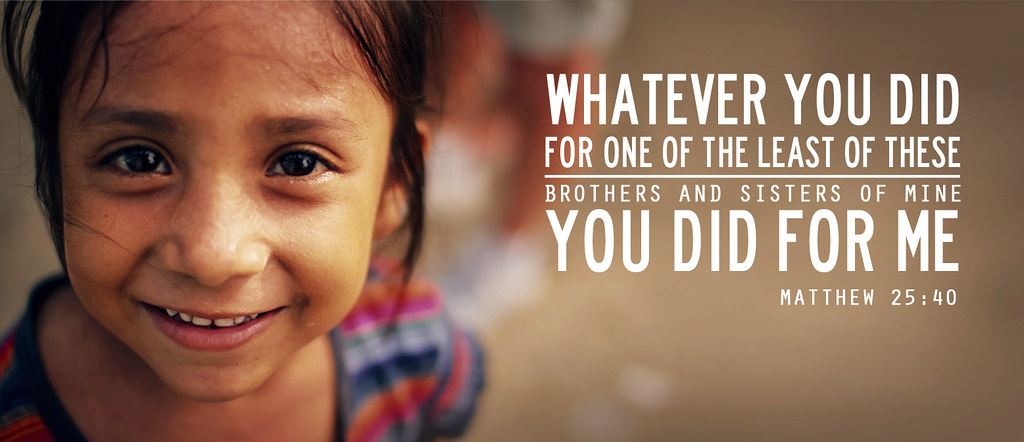
"Then shall the King say unto them on his right hand, Come, ye blessed of my Father, inherit the kingdom prepared for you from the foundation of the world: For I was an hungred, and ye gave me meat: I was thirsty, and ye gave me drink: I was a stranger, and ye took me in: Naked, and ye clothed me: I was sick, and ye visited me: I was in prison, and ye came unto me. Then shall the righteous answer him, saying, Lord, when saw we thee an hungred, and fed thee? or thirsty, and gave thee drink? When saw we thee a stranger, and took thee in? or naked, and clothed thee? Or when saw we thee sick, or in prison, and came unto thee? And the King shall answer and say unto them, Verily I say unto you, Inasmuch as ye have done it unto one of the least of these my brethren, ye have done it unto me."
Matthew 25: 34-40 

Actually, he said that every person we serve IS him.

Mother Teresa famously served the poorest of the poor in India. When people asked her how she did it, she responded, "This is Jesus in his most distressing disguise."

When we feed those who are hungry, we feed Jesus. When we welcome those who are strangers among us, we welcome Jesus. When we clothe those in need of clothing, we clothe Jesus. When we visit those who are sick and in prison, we visit Jesus. When we serve those in need, we serve Jesus. When we love anyone, we're loving Jesus.

And when we turn any of these away - we reject Jesus.

Every person we see is Jesus. Every person should be treated as if they are the God of the universe.

Wow.

Started with a goal to "see others as God sees them." Then realized "everybody is Jesus."

Guess I'll have to work a little harder to overcome that road rage.


Ways to serve Jesus right where you are:


  • Make blessing backpacks for the homeless. Click here for some ideas of what to include.
  • Volunteer at your local food kitchen or homeless shelter.
  • Renew the practice of bringing a casserole to welcome new families to the neighborhood. 
  • Clean out your closet and donate gently used clothes, coats, and shoes to a local clothing agency. 
  • Visit people in hospitals or nursing homes.
  • Visit people in prison. Or, if you're worried about safety, sign up to bake cookies! Click for more information.
  • Call your representatives to tell them you want legislation that feeds the hungry, welcomes strangers, clothes the naked, cares for the sick, and treats those in prison with justice and kindness. Click here to find your representative in the House. Click here to find your Senators.
  • TITHE. Whether it's to your local congregation or to your favorite charity, reclaiming the Old Testament practice of tithing the first 10% of our income to the work of the Lord is a powerful way to affect our world for good. Check out my favorite charity here. They partner with local organizations to help Syrian refugees, hurricane victims in Texas and Puerto Rico, low-income schools, and more - and because they're run completely by volunteers, 100% of donations go to those in need.Related image

Monday, January 22, 2018

Dear Pastor, Shaming Women is not the Word of God

Dear Pastor,

I recently listened to you speak in my hometown, and while I enjoyed and was uplifted by the majority of your message, there are two comments that I need to respond to. 

I say these things not to tear down, but to build up and encourage in love and kindness.

The first comment came towards the beginning of your message, during a story about your teenage girlfriend, Charmaine. When you dated, she was “FINE.” When you came to Christ, God told you to break up with her, which, of course, was difficult. After your wedding, you saw Charmaine. You implied that Charmaine had gained weight. And you thanked God for subtracting her from your life - implying that a fat person is unattractive and not worthy of marriage. 

This comment is hurtful to everyone. Women and men receive countless messages in our society about what their body is supposed to look like. When you include messages against certain body types in the context of a sermon, you are encouraging people to reflect the image of what the world defines as beauty. I do recall you beginning your message with a call to reflect the image of God - not the image of the world. 

When you gave this message, the building was packed. The message was streamed online. It may have been recorded and posted online for later viewing. Your message reached many people. Doubtless, some of those people were women and men whom society deems overweight or unattractive. Statistically speaking, a not insignificant portion of the people who heard your message have or will experience an eating disorder in their lifetime. This comment, which implies that fat people are unattractive and unmarriageable, tore those people down. This comment perpetuates society’s standards of beauty and repeats the message of “not good enough.” It is this kind of culture that contributes to our alarmingly high rates of eating disorders. These disorders are prisons. Anorexia nervosa has the highest mortality rate of all mental illness. Your comments contribute to that. 

The church should be a place where people are uplifted. Where it doesn’t matter what you look like - you are a child of God and you are loved and that is all that matters. Women who struggle with body image or eating disorders should not have to worry about triggering messages such as the one above when they are worshipping and hearing the Word of God. That message - that fat equals bad - is NOT from God. That is NOT that Word of the Lord. Thus, you as a man of God should NOT be preaching that. 

The second comment came in the second portion of your message, in discussion of your wife’s pregnancy. Pregnancy changes your appetite, you said. When we’re pregnant with God’s dream and plan for us, we’re hungry for God, and the things that used to fill us don’t fill us anymore. A wonderful point. And one that could have been demonstrated without the following harmful comment. Your wife was hungrier during her pregnancy. When you and your wife were out to dinner during her pregnancy, you hoped the night might end with some married intimacy. She finished her plate, and what was left of yours after you finished. According to you, she scarfed down the meal, with food dribbling down her chin - “Nah, now I’m turned off,” you said. 

A woman’s hunger is unattractive to you. The mention of this comment communicates that women are accountable to you for their attractiveness, that women are to be attractive to you at all times, even when sustaining normal bodily functions. Your message communicates that in order for a woman to be attractive, she must not be human. She must not hunger. She must not eat. She must not desire. 

And what a harmful message. It is the God-given nature of humanity to hunger, to fill ourselves with food, to choose food that pleases us, to enjoy the food we eat. God made us to enjoy food. But your comment teaches that this is not the case for women. Women are not to enjoy food. Women should suppress hunger and not enjoy food. Women should ignore and suppress their humanity. 

This is a message that, frankly, contributes to female oppression. In this comment, you position yourself as the head and command that woman deny her humanity in order to please you. You command that women live not for herself, but for your pleasure. 

Now, you may argue that “that’s not what I meant.” That’s okay. I’m sure you didn’t. I’m sure these things were said as jokes, to lighten the mood. The problem with that is that these jokes are harmful. Maybe you didn’t know that or hadn’t thought about these issues. That’s okay. The point is not to worry about what we did or knew in the past, but to concern ourselves with what we do and what we know now and in the future. Maya Angelou wrote, "I did then what I knew how to do. Now that I know better, I do better.” That is my concern. That after reading this letter, you will be equipped to improve and build a better world. I come not to chastise in hatred, but to correct in love. 

These kinds of comments are hurtful, plain and simple. 

As someone who has suffered from an eating disorder, I must react to and call out messages that shame people because of their body size. 

As a woman, I must react to messages that imply women are to remain small, silent, and hungerless - that women are to be anything less than fully human. 

As a follower of Jesus Christ, I am required to call out injustice and oppression wherever I see it. Comments that shame people for their body type and women for their natural hungers are unjust and oppressive. Christ came to break every chain, and comments like yours keep people in bondage. 

Thank you for your time, Pastor. 


Sincerely,

A Jesus Feminist in Recovery