Monday, January 8, 2018

Epiphany & the 12 Days of Christmas!

Image result for 12 days of christmas


Well, Christmas has come and gone. Hopefully it was a pleasant holiday for you and yours.

In the church calendar, Advent and Christmas are followed by a period called "Ordinary Time." This term, conveniently, refers to any time that isn't Advent or Lent (the season before Easter). Ordinary Time is filled with lots of little holidays, though, that vary from denomination to denomination. Not all of these are celebrated  by every church.

In the church, Christmas actually isn't just one day. Like most holy festivals - Chanukah, Ramadan, Chinese New Year - Christmas is traditionally celebrated over a period of time. We usually think that the 12 Days of Christmas begin before Christmas, with December 25 being Day 12. Wrong! The 12 Days of Christmas actually start on the night of Christmas Eve and lasts until January 6. The end of the Christmas season is marked by its own holiday, the Epiphany.

Epiphany remembers and celebrates when the wise men visited Jesus. It was more than 12 days later, but we shrink the whole Jesus story up to make it fit in one calendar year. Epiphany is always January 6, while Epiphany Sunday fluctuates. It's the Sunday closest to January 6.

As I said above, Epiphany Sunday remembers and celebrates when the wise men visited Jesus. Epiphany is a word that means "manifestation" or "showing." At the Epiphany, the wise men recognized that the Light of the World had manifested itself, had shown up. That's why they traveled - to visit the King.

The wise men, also called Magi, were from Persia. Magi means king - equivalent to emperor, pharaoh, etc. Think "we three kings." These kings were fancy, also studying math and science, especially astronomy. Some scholars believe that the wise men were Zoroastrian priests. Zoroastrianism is actually the world's oldest monotheistic religion (that we know of, I suppose), even older than Judaism. The religion gets its name from Zoroaster, a prophet who solidified most of the teachings. He was not God, and no one thought he was. They just named it after him. I guess this is very similar to how Mormons are called after the prophet who compiled our holy book, the Book of Mormon.

According to the story, the wise men were waiting for Israel's king. By studying the stars, they learned that the king had come, and they traveled to where Jesus was. And, though we put these nice gift-bearers in our nativities, it may have taken them up to two years to travel.

Today, we put stars atop our trees in remembrance of the star that shone when Jesus was born. It was the light of the star that helped the wise men know where they should go. We remember the coming of the Light of the World and we remember that it took time for the wise men to travel. Just like we don't just *snap* arrive at the Lord's feet. We've a journey, too. But no worries - we know God leads us home.
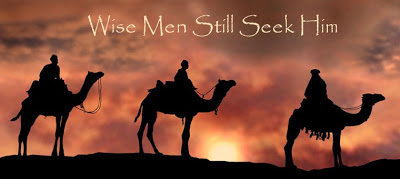
Image result for wise men still seek him


The voice of the Lord came unto him, saying:

Lift up your head and be of good cheer; for behold, the time is at hand, and on this night shall the sign be given, and on the morrow come I into the world, to show unto the world that I will fulfil all that which I have caused to be spoken by the mouth of my holy prophets. . . .

And it came to pass that the words which came unto Nephi were fulfilled, according as they had been spoken; for behold, at the going down of the sun there was nodarkness; and the people began to be astonished because there was no darkness when the night came. . . .

And they began to know that the Son of God must shortly appear; yea, in fine, all the people upon the face of the whole earth from the west to the east, both in the land north and in the land south, were so exceedingly astonished that they fell to the earth.

For they knew that the prophets had testified of these things for many years, and that the sign which had been given was already at hand . . .

And it came to pass that there was no darkness in all that night, but it was as light as though it was mid-day. And it came to pass that the sun did rise in the morning again, according to its proper order; and they knew that it was the day that the Lord should be born, because of the sign which had been given.

3 Nephi 1:12-19

Friday, December 29, 2017

Reader Report: Best Books of 2017

For 2017, I set a goal to read 100 books.

I spent a LOT of this year reading. Sometimes it was boring, but mostly, it was awesome. I crossed so many books off my to-read list. I laughed and I learned. I don't think I'll read 100 books next year, but I will keep reading.

As the year draws to a close, I wanted to compile a list of some of the best books I read this year.


Nonfiction - Religion

The Faith Club: A Muslim, A Christian, A Jew - Three Women Search For Understanding

Rayna Idliby, Suzanne Oliver, and Priscilla Warner

In this book, three women meet to collaborate on a children's book promoting religious literacy and interfaith dialogue. On the way, they realize their own misconceptions and work towards greater interfaith understanding. Religious people - read this!

What We Talk About When We Talk About God

Rob Bell

Rob Bell, man. Rob Bell is a pastor of an American church and a theologian for the common people. Bell is treading new paths and redescribing the way we look at God and the Bible - and you don't need a doctorate to understand. This books presents God as bigger, fuller, more complex than what we have thought in the past. Bell challenges us to think of a God who is bigger than us and what we've been thinking, a God who challenges us to be more.

Mormon Feminism: Essential Writings

Joanna Brooks, Rachel Hunt Steenblik, and Hannah Wheelwright

This book is so, so good. Brooks, Steenblik, and Wheelwright compile a new collection of essays, fiction, and poetry on Mormon feminism from the 1970s onward. Some if new historical studies into Mormon history and Mormon women's involvement in the women's movement early on. Others describe current issues and offer alternative paradigms and possible solutions. Whether you agree or not, this is a good book to understand where Mormon feminists are coming from. Mormons - read this!

How Do You Spell God?

Mark Gellman & Thomas Hartman

A rabbi and a priest team up to write a religious education book for older children and preteens. Covering the world's six major religions (and some smaller ones!) this book compares ideas of God, heaven, morality, clergy, and more. Heart information, accessible even to kids. Religious literacy is so important, and this book is a wonderful tool!


The Power Of Myth

Joseph Campbell with Bill Moyers

Joseph Campbell, a scholar of comparative mythology, covers all kind of topics - sin, salvation, heroes, ritual, marriage, and more. What is the value of myth to religion? And how do various mythologies convey the same religious truths? Campbell addresses this and more with Bill Moyers.

Excavating Jesus

John Dominic Crossan and ‎Jonathan L. Reed

A former Catholic priest and an archaeologist team up to present the historical Jesus in his first-century Palestinian context. With detailed descriptions of archaeological evidence and careful readings of written evidence in the gospels, Crossan and Reed build an engaging portrait of what this man's life may have looked like. Christians - read this!

Fiction

The Jungle 

Upton Sinclair

First described to me as a novel about unsanitary meat packaging, this novel is so much more. Sinclair tackles life for immigrant families at the turn of the 19th century, life for the poor, life for working class. The protagonist family suffers repeatedly at the hands of the wealthy. Injustice exposed. Eye opening. Rich people - read this!

Franny And Zooey

J.D. Salinger

This book doesn't really have a plot. But it's one of those novels that has such beautiful prose that you just want to drink. You just lay there looking at this book and read it over and over and try your best to soak up the beauty. 

Journey To The East

Herman Hesse

Another of those "drink it up beautiful" novels. It's about a pilgrim who, you guessed it, journeyed to the East looking for spiritual fulfillment. 

The Stepford Wives

Ira Levin

One neighborhood, a men's club up on a hill, and women who only want to keep house. Suspicious? This one keeps you on the edge of your seat, for sure.

A Lesson Before Dying

Ernest J. Gaines

Two black men struggling to live fully in southern Louisiana. One in jail, one a poor teacher. Both are changed. Enlightening on issues of race. White people - read this!

Monday, December 18, 2017

Emmanuel

Emmanuel. "God with us."

Before Jesus was born, an angel visited Joseph and told him what to call Mary's baby. One of those names was Emmanuel. Translated, "God with us."

Sometimes, we think Emmanuel means that nothing bad will ver happen. Sometimes, Christians of all varieties imagine that life with God will be free from strife. Sometimes non-Christians or non-religious people think that God and religion are an opiate that solves problems. Not so.

And I don't think that's what was meant by "Emmanuel."

Instead, Emmanuel means that the worst thing will never happen to us - being away from God. Being completely, eternally alone.

Emmanuel means that God is with us always. That God cares.

We couldn't go all the way to God on our own, so God came. Emmanuel. God with us.

Emmanuel means that even though we're imperfect and messy and confused, God wants to be with us.

Emmanuel means that there will never be any space between us and God.

Emmanuel means that we are never alone.

Emmanuel means that God wants to be with us forever.

Emmanuel means that God will always be as close as our breath. Breathe in, breath out. There. That's God. Right up in our noses. So close. The words originally used in the Hebrew and Christian Bibles for Holy Spirit are in Hebrew ruach and in Greek pneuma. Ruach is the Hebrew word for wind. In Genesis, when God's spirit brooded over the waters before creation, that word is "wind." God's wind was there, God's breath. The Greek pneuma is recognized in English pneumonia. Breath. God is breath. Emmanuel.

Emmanuel. What a miracle. Emmanuel for all. Emmanuel not only for the rich and powerful, but those like babies and children - those who are small, helpless, without rights. Those who cannot help themselves. Those who have nothing at all to offer. Emmanuel. For those like this. For us.

Emmanuel means that everyone's invited and there's nothing we can do to earn our invitation and there's nothing we can do to take it away.

Emmanuel means that God already came down and delivered our invitation and scooped us up and brought us to the heavenly banquet.


When we worry we're not good enough - Emmanuel. God with us.

When we're scared  - Emmanuel. God with us.

When we're sad - Emmanuel. God with us.

When friends aren't being so friendly - Emmanuel. God with us.

When the prognosis is bad - Emmanuel. God with us.

When college and work is real tough - Emmanuel. God with us.

When there's no job and no money - Emmanuel. God with us.

When there's cancer - Emmanuel. God with us.

When there's depression and anxiety and eating disorders - Emmanuel. God with us.

When we don't know what's up next - Emmanuel. God with us.

When faith is hard to come by - Emmanuel. God with us.

When we wonder if we've ever felt the Holy Spirit speak peace to us before - Emmanuel. God with us.

When we've messed up REAL bad and feel we'll never be able to make restitution - Emmanuel. God with us.

When oppression seems to reign - Emmanuel. God with us.

When the fight for justice feels neverending - Emmanuel. God with us.

When racism and sexism and homophobia and islamaphobia and antisemitism and xenophobia seem rampant - Emmanuel. God with us.

When children are homeless and cold and hungry and we can't save them all - Emmanuel. God with us.

When the justice system puts innocent people away - Emmanuel. God with us.

When abusers run free and victims have to live in fear - Emmanuel. God with us.


And, when life is rainbows and sunshine and bowls of ice cream - Emmanuel. God with us.

All the time.

Highs and lows.

Hills and valleys.

In the harvest and in the famine.

Both/And.

Emmanuel.

God with us.


Friday, December 15, 2017

Advent & Annunciation

As I said in my previous post, I have been teaching Sunday School to a group of crazy awesome elementary schoolers. I inherited a curriculum organized around the church year - All Saint's Day, Reformation Sunday, Advent, Epiphany, Lent, Pentecost. We're teaching our kids about all of those little holidays that have been honored by Christians for hundreds of years but are often overlooked. Now, we're in Advent, the time when the church universal prepares for the coming of Jesus Christ, both his coming as a baby and his coming again.

As I'm growing up into adulthood, I am appreciating more and more the seasonal changes that help us as humans keep time through the year. While I usually complain about holidays in terms of "why the heck do we have to have like one day that's randomly different from all other days for no reason?? why do we have to change our schedules and stress over family and big meals??" Despite that, I am beginning to understand and value these seasons that allow us to focus more specifically on certain parts of life or faith. While we can definitely celebrate Jesus' birth, for example, at any time through the year, there is value in dedicating a season to meditating on the lessons of this story each and every year.

These stories are rich with metaphor and symbolism. Most scholars agree that Jesus probably wasn't born on December 25. We don't have any recorded dates, and Christmas wasn't celebrated until a couple hundred years after the fact.

Christians began celebrating Christmas on December 25 because they were recycling and repurposing a pagan holiday. Before electricity and advanced agriculture practices, humans relied on the patterns of the sun and moon - days, months, years. They noticed patterns that we, with 24-hour light and vegetables that are in season all year long, overlook. Winters can be hard now, but they were deadly for humans past. They watched the passage of the sun, they noticed when the days got shorter, and they celebrated the winter solstice as the day that the sun returned. They celebrated the return of light to the world. It was not uncommon for this day or time to be celebrated as the day of the birth of the Sun God.

Later, Christians co-opted the holiday to celebrate the birth of Jesus Christ, who from very early in the Jesus movement was called the "Light of the World" (John 8:12, 9:5). Jesus - the Son of God - replaced the Sun God, and His birth began to be celebrated near the winter solstice.

Advent, as the time when we prepare our minds and hearts for Christmas, is a time when we meditate on the Light. We think about how no matter how dark the world gets, God will always send light. This world has been going around for thousands of years, so winter has ended thousands of times. God has sent light to the world all those times - will not God do so again?

Traditionally, the church universal has assigned a certain theme to the four weeks of Advent - hope, love, joy, and peace. In this second week of Advent, I taught a Sunday School lesson about Love. We talked about how God loved us by sending Jesus, by sending the Light. We watched some darling videos about Mary, Joseph, and Elizabeth. Click below to watch (they're kiddie, but so so good):

We talked about how God loved us, so God sent Jesus. We talked about how God showed love by telling us about the gift of Jesus - God sent an angel to Mary and a dream to Joseph. Then, Mary loved Elizabeth by sharing the news of Jesus. 

I so love the little video of the annunciation. It's a story I love in general. I love Mary's hymns in Luke. What I really love about this video is how it handles Mary's "but I'm a virgin!" questions. I love that when the angel says, "you're going to be his mom," Mary knocks the stool over and falls down. It's so cute and so relatable. 

Then she says, "Are you sure you've got the right girl? God must have meant someone else." The implication is - "I'm nobody. I'm not cool or great or especially faithful. I'm just a normal person. Are you sure God wants to use me?"

And isn't the the question we all wonder upon receiving a calling? God, are you sure you want me? 

But the angel says, "Yep! God wants you." Why? "Heaven only knows." Just cause. Just cause I want you. Just cause I love you. Because I'm God and I get to pick whoever I want and I pick you. "I have loved thee with an everlasting love: therefore with lovingkindness have I drawn thee" (Jeremiah 31:3). 

God loves, so God calls and God gives gifts and God sends messages. 
Artwork depicting the Annunciation (Google Images)
 And the angel answered and said unto her, "The Holy Ghost shall come upon thee, and the power of the Highest shall overshadow thee: therefore also that holy thing which shall be born of thee shall be called the Son of God. . . . For with God nothing shall be impossible." 
And Mary said, "Behold the handmaid of the Lord; be it unto me according to thy word." And the angel departed from her. 
And Mary arose in those days, and went into the hill country with haste, into a city of Juda; And entered into the house of Zacharias, and saluted Elisabeth. And it came to pass, that, when Elisabeth heard the salutation of Mary, the babe leaped in her womb; and Elisabeth was filled with the Holy Ghost: And she spake out with a loud voice, and said, "Blessed art thou among women, and blessed is the fruit of thy womb. And whence is this to me, that the mother of my Lord should come to me? . . . Blessed is she that believed: for there shall be a performance of those things which were told her from the Lord." 
And Mary said, "My soul doth magnify the Lord, And my spirit hath rejoiced in God my Saviour. For he hath regarded the low estate of his handmaiden: for, behold, from henceforth all generations shall call me blessed. For he that is mighty hath done to me great things; and holy is his name."

Sunday, December 10, 2017

Not Your Average Mormon

For quite a while, I've been meaning to try to write here more often. Obviously, that hasn't really happened.

Instead of aiming for any deep theological reflections, my goal will be simply to post weekly - small reflections or meditations about what I've been studying, talks I've heard, things that have happened. Fingers crossed, and maybe hoping to receive some grace to keep up with it?

I'll start today with a little bit of a background of what's going on lately.

I unofficially left the LDS church in April 2016. That was really rough for me. I spent a couple months believing there was no god, then spent a couple months exploring various expressions of faith and spirituality. For nearly a year, I have been attending a nondenominational church in my area off and on, and flirting with the idea of returning to my LDS ward. I've watched every general conference since I was baptized, and have read the Book of Mormon infrequently since leaving. Like I said, going back is an idea that's been tugging at my mind lately. That's a whole big bag of complicated that I can't get into now. It would take way too long, and besides - I don't even know where I am with that exactly, so I surely am not in a place to explain it fully. As Liz Gilbert said regarding one aspect of her life in an interview, "It's something I'm living in right now, so I can't really say too much about it." I'm going to focus on being present in my faith journey, rather than trying to turn it into a story prematurely. The point: Mormon, not Mormon, kind of Mormon - confused.

For about two and a half years, I have been employed at a Methodist church (the church where I grew up), as an assistant in the children's ministry.

One month ago, my supervisor at work resigned unexpectedly. I have since stepped up into some of her roles, including teaching Sunday School to about 60 elementary schoolers and dealing with extra programming. This has given me a great opportunity to do some good studying and evaluation of what I believe. It has been enlightening and a lot of fun. I have stepped into these roles prayerfully.

I say that because some of the things I bring up in these reflections or meditations will be inspired by the things that I'm studying and teaching on Sunday mornings.

It's kind of funny, my boss stepping down. For over a year, as I've toyed with religion, I have explored many traditions, but felt that nothing fit exactly. There's a lot that I like from all different places, but nothing seemed to work exactly. After a while of this, I realized that every religion and every denomination would have things that weren't perfect, things that I didn't exactly believe, problematic pieces of history. I knew that I'd find a depth of religious experience as I chose one - though imperfect - and devoted myself to a tradition and to a people. I was frozen, though, because I didn't know which tradition to choose! And now I teach children about Jesus in the Methodist tradition. I'm learning all kinds of things about the Bible and Methodism. I don't know if I'd call myself Methodist right now, but I do think it's . . . interesting that God kind of shoved me into a faith community.


Despite this all - the questioning, the Methodist church - I write on this blog which has attached the identifier "Mormon."

I love the LDS church. I love the Book of Mormon, and I love our prophets. I love Joseph Smith and the movement that he started.

I love the Relief Society. I love Mormon women. I love Emma Smith and Eliza Snow and Emmeline Wells. These are the women I call my spiritual ancestors. They came before, and I follow their footsteps, because they were faithful, courageous, strong- and I want to be those things, too. I love every Mormon woman I have met in my wards; they have all taught me something valuable about life and love. I love the sister missionaries (those who were full-time and those who personified the call "every member a missionary") who met with me when I was in darkest night, who loved me when I was unlovable, who courageously accepted the call to serve their God, who persevered in proclaiming their faith boldly. They are an inspiration, and thinking of them brings tears of gratitude to my eyes.

I love this church. I may not love everything about it, but I love it. People say you can't choose your family, but you can choose your friends. Well, this church is my family. This is where my heart is, and may always be. This church chose me, sought me out, loved me when I was alone, and healed me when I was broken. I am forever indebted to this church; it will always have a place in my heart and in my life.

I'm not orthodox. Not even close. I never will be "just your average Mormon." Nevertheless, I remain glued to this church by my baptism and by the spiritual bonds that have been built by heaven's hands.

Kirtland Temple (source)

Sunday, September 24, 2017

Brigham Young on Government

I was reading recently in The Teachings of the Presidents of the Church: Brigham Young. The chapter on "Earthly Governments and the Kingdom of God" seemed especially relevant in our current politcal climate.


What a government based on the Kingdom look like? 

President Young said that if the Kingdom of God ruled on earth, "Every one would be fully protected in the enjoyment of all religious and social rights, and no state, no government, no community, no person would have the privilege of infringing on the rights of one another. . . . Whoever lives to see the Kingdom of God fully established upon the earth will see a government that will protect every person in his rights" (268). 

Young reminds us that the Kingdom of God does not force anyone to do or believe anything. As such, "If that government [the Kingdom of God] was now reigning . . . you would see the Roman Catholic, the Greek Catholic, the Episcopalian, the Presbyterian, the Methodist, the Baptist, the Quaker, the Shaker, the [Hindi], the [Muslim], and every class of worshippers most strictly protected in all their municipal rights and in the privileges of worshiping who, what, and when they pleased" (268). Our country and church leadership would do well to work harder on to "protect every person in his rights" and ensure that "every class of worshippers [are] most strictly protected," rather than allowing Jews and Muslims to suffer and die as refugees abroad or victims of hateful actions domestically.


What kind of leaders are needed for such a government?

President Young also spoke about good leaders and the traits necessary for leadership: "[A good leader] should understand what administrative policy would be most beneficial to the nation. He should also have the knowledge and disposition to wisely exercise the appointing power. . . . He should not only carry out the legal and just wishes of his constituents, but should be able to enlighten their understanding and correct their judgement. And all good officers in a truly republican[*] administration will constantly labor for the security of the rights of all, irrespective of sect or party. . . . We want [people] to rule the nation who care more for and love better the nation's welfare than gold and silver, fame, or popularity" (269). 
  1. Knowledge and Understanding
  2. Carry out the legal and just wishes of this constituents
  3. Constantly labor for the rights of all, irrespective of sect or party
  4. Care more for and love better the nation's welfare than money, power, or fame


How are Latter-Day Saints expected to participate in such government?

President Young spoke regarding electing representatives, saying, "We will vote for the man who will sustain the principles of civil and religious liberty, the man who knows the most and who has the best heart and brain for a statesman; and we do not care a farthing whether he is a whig, a democrat [etc]" (270). 

After election, "We will pray for them and give them our faith [trust] and influence to do the will of God and to preserve themselves and the people in truth and righteousness" (270). Here, I do not believe the President Young is saying that the Saints are to vote, pray for our representatives, and leave it at that. He also says we should "influence" them - in today's words, an injunction to phone and write our representatives to tell them what we believe they should do and how they should act in given situations. We are to influence our representatives "to do the will of God." What does this mean? Well, I think the next part of the sentence partially explains that: "to preserve themselves and the people in truth and righteousness." We are to guide our representatives to act according to principles of truth and righteousness. We are not to allow or representatives to act based on falsehoods, assumptions, or bigotry. Remember, President Young said that the a Kingdom government "will protect every person in his rights."


"Are we a political people? Yes, very political indeed." 
President Brigham Young 

So, Latter-Day Saints, follow the prophet in all areas of your life, including government. May I remind you that Jesus of Nazareth was executed on a Roman cross for defying the government and calling for social, economic, and religious justice for the Jewish people. May we not be afraid of a fate like Jesus in fighting for the Kingdom he initiated. 


*Republic - "a government in which supreme power is held by the citizens entitled to vote and is exercised by elected officers and representatives governing according to law" (Merriam-Webster Dictionary).

All images from lds.org.

Sunday, September 17, 2017

Amazing Grace


Amazing grace
How sweet the sound
That saved a wretch like me
I once was lost, but now I'm found
Was blind, but now I see

Through countless dangers, doubts, and fears
I have already come
God's grace has brought me safely here
And grace will lead me home

My chains are gone
I've been set free
My God, my Savior has ransomed me
And like a flood His mercy rains
Unending love, Amazing grace
His mighty hand shall be my stay
His strength with me abounds
And though I stumble day by day
He shall not leave my side

My chains are gone
I've been set free
My God, my Savior has ransomed me
And like a flood His mercy rains
Unending love, Amazing grace
The earth shall soon melt like snow
The sun refuse to shine
Yet God, Who sent me here below
Will be forever mine