Showing posts with label my life. Show all posts

Wednesday, March 28, 2018

Three Years

Three Years.


As a new member, I used to pray often that I never lose sight of how grand and glorious a blessing the gospel is.

Well, it didn't work. This year, my baptism anniversary totally caught me by surprise. I have not been reflecting all week about what baptism means to me or how this past year has gone. Nope, haven't thought about it a bit.

What does baptism mean to me? Particularly, what does my believer's baptism into the LDS church three years ago mean to me?

That day was the first time I really made a decision for me, regardless of what anyone else said or thought I should do. Some people told me I shouldn't join the church, that I didn't know enough, that it wasn't safe. I said I'd never know "enough" to commit myself to any church, and I was choosing this one on faith. I know I might get hurt, but I took the risk anyway, believing that life will hurt me wherever I got and trusting that God would be with me through the hurt.

And I have been hurt. Not necessarily by the church. Just by life. And I think God has been with me. Or perhaps God is truly with us whenever we think to acknowledge God's presence. Really, I believe God is everywhere, all the time. That's the kind of God I believe in. A lot of times we feel without God simply because we have failed to see what's right under our noses - plenteous provision.


Baptism. A forgiveness. A rebirth. A cleansing. Baptism means that my past has no power over me. My past before my baptism, and my past since. Baptism means that the best is yet to come.

Baptism. A testimony. A loud proclamation of what God has done in my life and what God will do. In the waters of baptism I publicly proclaimed my belief in the Savior God, proclaimed His work in my life, and proclaimed bright hope for what lay ahead. Baptism is a testimony of God's faithfulness - past, present, and future.

Baptism. A covenant. A covenant to always remember the Lord and the work He has done for me. To always remember how the Lord has delivered me and saved me. How the Lord has given me worth when I felt I had none. How the Lord has organized and been sovereign over the details of my life. Remember.

Remember. Re-member. Come together, Baptism is a covenant to come together, with knowledge of my true self, with my God, and with God's people. At baptism I covenanted to re-member myself to God, and God promised to always re-member me. God promised to never leave my side. I promised to never forget God's presence at my side. How intimate and holy.

At baptism, I also covenanted to re-member God's people, to be present and vulnerable and true with the communion of saints. To take God's people as they are. To pursue authentic community, not just superficial "Hi, how are you?" This might be what I have failed most at. I'm not really a people person, or so I like to say. We're all people persons. God made us that way, to live in community, to live in relationship, to live face-to-face with other humans. That's why we Christians often describe God as a community - Father, Son, Holy Spirit - because that description rings to true to a reality that we have experienced in our lives.


For the past six months, I have been working in a Methodist Children's Ministry. Teaching children who God is, helping them discover God's character for themselves, sharing stories of Jesus, trying to answer brilliant questions, and honoring the season of Advent and Lent as a community. This has all been a joy. I have had the opportunity to research and think deeply about what I believe, who I am, and where God may want me. I don't think I'm Methodist, and that's okay.

I have loved immersing myself deeply into the liturgical calendar, which I'd never given much thought to in the past. I love the cycle of honoring seasons and seasonal changes. Our God is the God of seasons. Our world has seasons, how can we worship a God without or live a life without seasons? I love the liturgical calendar for the rhythm it gives me, the way it grounds and centers me to thinking deeply about certain subjects. In Advent and Lent, we have meditated on darkness.

In Advent, the world was dark and waiting for light. And then - light came! Just after the winter solstice, as light is returning to earth, we celebrate the birth of God's Light in our world! Then we had a short season of meditating on the life of Jesus and the things he did in a mortal body just like mine. What wonderful stories.

And now, we rest in Lent. We wait for Easter. We wait for spring. We wait for resurrection. We wait for God to bring new life.

We wait for baptism. We wait for April showers and May flowers. We wait for God to bring a cleansing on our lives and on our world. We wait as God does work that we cannot see, trusting that work is being done and that we will see the May flowers.

Spring is a time of baptism. Easter is a time of baptism. I now see why the Catholic tradition baptizes yearly on Easter Sunday. It makes so much sense.


You're the God of Seasons, my Lord.
Through summer and winter, through desert and harvest, though Advent and Lent,
          You are there.
My Lord and my God, I trust that you are working, even when I cannot see.
Work in me, Lord. Work in me and work in my life. Let me be a tool in Your hands.
Bring life from death, and let me be a field hand to aid Your work in the lives of others.


Three Years.

Thursday, March 1, 2018

Prayer: Reflections for Lent - Yoga

Most people associate yoga with sweat, butts in faces, and maybe farts. We in the West have no idea. 

Yoga is an ancient practice originating from the Hindu religions of India. The word yoga comes from a Sanskrit word meaning “to yoke” or “to link.” Think yoking, like Jesus said, “Take my yoke upon you.” The whole point of yoga is to be linked and yoked - mind to body, thinking self to the true or inner Self, human to the Ultimate Power, to God. 

In the West, we think of yoga as physical, something you do in workout clothes at the gym. But this is only a small part of what yoga actually is.

Yoga is a collection of “spiritual disciplines designed to clear the mind and support a state of serene, detached awareness . . . [and] balance, purity, wisdom, and peacefulness of mind." 

There are four basic types of yoga, or paths: raja, jnana, karma, and bhakti. 

Raja yoga is the path of mental concentration, or meditation. An ancient teacher of yoga describes eight “limbs” of yogic practice including moral codes, physical conditioning, breath control, concentration, meditation, and a “state of peaceful absorption.” The first limb, moral and ethical principles, are similar to what is found in spiritual paths worldwide - truth and honesty, not stealing, not coveting, devotion to God, and others. The second limb, physical conditioning, refers to asanas, or poses. This is what we Westerners usually think of when we think yoga. The other limbs refer to breathing, mantras, and other tools to focus concentration. 

It’s important to realize that at it’s core, yoga is for the mind and spirit - not the body. We often reduce yoga to a physical exercise, but in fact the physical portion is just a tool to achieve mental concentration, spiritual wisdom, and connection to the divine. 

Jnana yoga is the path of “rational inquiry.” While raja yoga attempts to transcend our rational mind to receive spiritual enlightenment, jnana yoga uses the mind as a tool to gain spiritual knowledge. This might be compared to philosophical or apologetic endeavors in Christianity. 

Karma yoga is the path of “helpful action in the world.” The two previous paths, raja and jnana, have been inward paths focusing on meditation and the self to gain enlightenment. Karma yoga grows closer to the divine by helping others. Mother Teresa is famous for acknowledge that she serves not the poor of Calcutta, but “Jesus in his most distressing disguise.” She knew that every action to those around her were actions done to Jesus - that is the path of karma yoga. 

Bhakti yoga is the path of personal devotion, and the most common among Hindus. This pathos one where the human is completely in love with and utterly devoted to a deity. One Hindu poem reads: “Thy Name is beautiful, The form is beautiful, and very beautiful is Thy love, Oh my Omnipresent Lord.” In this path, “the devotee’s whole being is surrendered to the deity in love.” This reminds me of the Hebrew “Song of Songs,” when it is interpreted as a song between the Lord and humanity, or of nuns who consecrate themselves as being “married to Jesus.” This is the path we follow when we sing songs of love and devotion:

“Heaven meets earth like a passionate kiss, and my heart beats violently inside of my chest, and I don’t have time to maintain these regrets when I think about the way He loves us.”  
“Oh, the overwhelming, never-ending reckless love of God - it chases me down, fights till I’m found.”  
“Jesus, we love you, oh how we love you. You are the one our hearts adore. . . . Our affection, our devotion, poured out on the feet of Jesus.” 
“How we love you, how we love you, how we want you, how we want you. . . . Your love we can no longer keep inside. It’s opened up our eyes; It makes us want to sing.”
As we can see, these three yogic paths - jnana, karma, and bhakti - have parallels which we are familiar with. Thus, I will focus now on the spiritual discipline of raja yoga. We are familiar with the first limb, the moral codes. In the West, our religions certainly require certain moral action. 

We don’t often think about how the asanas (poses), breathing exercises, and mantras can be used to facilitate connection to the Divine. And truthfully, I don’t know if I can explain how this happens. Maybe that’s something that I love about it - I don’t know how it works but I know that it does. I know that when I do sun salutations in the morning, my mood is lifted. I know that when I take time to be still, I touch something deep inside of me that is the same essence of that which is central to the soul of the Universe (wow, sounds wacky). But really, when I engage in this practice, I’m surrendered. I can’t push my body to do things it can’t do, and there’s no reason to. This is an exercise in radical acceptance - of my body, of my self, of my circumstances, of the people around me, of the world. This is a place for me to acknowledge that I am not in control - and come to terms with that. The long inhales and exhales slow my heart rate, slow my thoughts, slow my anxieties. It allows me to let go of my worries and hand them off to the Person who “will generously provide all [I] need” (2 Cor 9:8). 

I know that sometimes I wake up and I don’t know what to pray. I feel lost and broken and without words. So I sit cross-legged and say to the Almighty, “Lord, here I am. Surrendered.” And then I proceed to use this body that is a “temple of the Holy Spirit” and breathe this breath that is not mine but belongs to every living being collectively. I am connected to everything else by this breath, which comes into my lungs after being used by someone else, and which will leave my lungs to give life to someone else. This practice reminds me that we are all One. This life force, this breath, this ruach - it comes to me from the Divine. It connects me to the infinite, it connects everyone else to the infinite, and it connects all of us to one another. 


With this humbling reminder, with this use of my body for something good and beautiful, I am calmed. I have prayed, I have connected with the Divine, and I have been changed by the encounter. 


All quotes are from Mary Pat Fisher, Living Religions.
~ ~ ~

This post is the second in a series, Prayer: Reflections for Lent, which explores prayer in a variety of ways. Click below to read previous posts: 

Come back on Thursdays during Lent for the next post! 

Monday, February 26, 2018

NEDAwareness: What We Want You to Know About Eating Disorders


I've never blogged for NEDAwareness, though this is something that's dear to me and something I post about on Instagram almost every year. Earlier this evening, though, I had the idea to write something for this week, though I wasn't sure what kind of post I'd write. Links to awareness websites and support resources? Personal experiences? For whatever reason, these didn't seem right for this time.

I settled on what we, people living our lives with this disorder, want you, those who are not and have not dealt with these particular struggles, to know about us and our illness.

While I know that some of my ideas are shared by others with eating disorders, I should specify that I didn't give this enough forethought to survey the community. Thus, I really should call this "what I want you to know." I understand that I come from a privileged position in this discussion. I am white, I am female, I became ill as an adolescent, I usually fall on the normal-thinner side of average, and my illness was primarily restrictive. My voice is the voice that we often see from this community. My family had the resources to seek treatment for my disorder. We had insurance that helped pay treatment and medication costs. I lived in an area with several professionals to choose from. My story is SO not everyone's story. There are struggles that come with having this disorder in a different body, in a different socioeconomic status, in just different circumstances. My perspective is not final or representative of everyone's. I encourage you to read the stories of people with eating disorders whose stories do not often get heard. The National Eating Disorders Association has a wonderful Marginalized Voices project which presents the perspectives of those voices often overlooked in the walk towards awareness.

In pursuit of awareness surrounding eating disorders, my hope is to address some of the myths surrounding eating disorders and the people who struggle with them, as well as to possibly talk about some things that may not get talked about as much. Some of these deal with the disorder itself, some of them deal with recovery.


With all of that said, here's what we want you to know.


We're not all women.

We're not all white.

We're not all adolescents.

We're not all rich and spoiled.

We're not all thin.

We're not all straight.

We're not all cisgender.

Eating disorders can affect anyone, at any time.

It's not as simple as "just eat a burger!"

We're not just doing it "for attention" (in my experiences with people I've spoken to, sometimes the intention is just the opposite - to fade away and disappear).

You can't make us recover before we're ready. Pushing or forcing someone into recovery won't work. You might see a decrease in behaviors, but without the full commitment of the person, they're likely using different behaviors and hiding them from you.

Recovery is really hard.

Recovery is not just about weight restoration. This is really really important for those who have lost weight, but reaching a healthy weight is by no means the end.

People don't have to be losing weight to have an eating disorder.

People don't even have to want to lose weight to have an eating disorder.

Not all eating disorders are restrictive (like anorexia, which involves restricting food intake to certain amounts, food groups, times, etc).

Not all eating disorders involve purging (vomiting, laxatives, extreme exercise or fasting to overcompensate for eating, etc).

People with Binge Eating Disorder aren't just lazy, fat, slob, whatever else might be used to describe them. It's a real illness that needs to be treated by a qualified team of professionals.

Don't forget Other Specified Feeding or Eating Disorder (OSFED, formerly EDNOS). This is a diagnosis that might be used to describe individuals who use behaviors that cross diagnoses (ex. restricting along with binging in purging in cycles), or who experience all symptoms of anorexia but are not underweight or do not have amenorrhea. (Read about it here) It might be complicated, but the main point is: it's not just anorexia and bulimia.

It's not about vanity. Most of us couldn't care less about what the world thinks of how we look. We're too concerned with like, having a mental illness.

Just because we think we're fat, doesn't mean we think you're fat.

Please don't belittle us or devalue our feelings and fears. You don't know what it's like to think of dinner and have a full-blown panic attack. You just don't know. This is an illness of the mind that alters normal responses to hunger, food, and fulness. Please respect our feelings and fears, and believe us.

This is SO not about food. It's actually about a lot of other things - depression, stress, societal beauty standards, perfectionism, a hyper-controlled childhood, or a grocery list of other causes.

While eating disorders aren't caused by New York Fashion Week and Victoria's Secret models, a culture obsessed with thinness and dieting does contribute. We live in a culture that is constantly telling us that thin is best, that eating is a reward, that we work out to burn off calories, that we should be dieting and counting calories, that it's good for young people to participate in dieting programs. That thin and fit are more worthy of life and love. Terrible message. When people feel they are unloved, unworthy, undeserving, our culture gives them an easy fix - just lose weight and you'll be happy, you'll be lovable, you'll be loved, you'll be worthy. That's the trick. And that culture is a lie. Dismantling a culture defined by patriarchy, able-bodiedness, white supremacy, heteronormativity, and the like is crucial on the path of a systemic fight to prevent eating disorders.

These are addictions. Just like alcohol, just like cocaine. Some theories propose that people with restrictive eating disorders have an abnormality in the part of the brain that deals with hunger cues and rewards. Usually, humans experience hunger, feed ourselves, and the brain releases chemicals lifting our mood. For people with restrictive eating disorders, the opposite can happen - hunger itself can light up the brain's reward system. So rather than getting hangry, we might feel high. The same can happen after purging. Like an addict looks for the bottle or the drug to lift the mood after a hard day, someone with an eating disorder will look for the behavior that lowers stress and brings a high, whether it's fasting, purging, exercise, or another behavior.

Recovery doesn't happen overnight.

Just because someone is weight restored and behavior-free, that doesn't mean their mind is healed. And since this is an illness of the mind, a behavior-free but ill mind will in time revert to those old behaviors.

Some of our rules about food, fears about food, or practices surrounding food or our bodies might seem weird to you. If it's just "weird" and not dangerous, let it go. We'll work with our treatment team to achieve healing, and you just support us where we're at. Let us be weird while we're healing.

Don't yell, fuss, shame, scold, or the like if we use behaviors. It's not a disciplinary problem, it's a mental one. Instead, ask about what happened to cause the urges, and deal with that.

Talking about how gross vomiting or laxatives is won't stop us from using those behaviors.

Commenting on our weight loss or restrictive eating patterns with envy, cooing about how you "could never do that" is really . . . just don't do it. Don't be jealous of the weight loss. Don't envy the "self-control" people with restrictive eating disorders have. It's just not cool. Eating disorders are so not cool or enviable.

PLEASE don't comment on our body size or how we look. Not that we've gained or lost or "look healthy" - nothing. This can be quite triggering, and there's lots more cool stuff to talk about. "Wow, the weather, huh?!?" (The only exception I can think of is if you know someone in recovery from a restrictive or purging eating disorder who seems to be losing significant weight and isn't in treatment - then you might think about GENTLY voicing your concern.)

We might be real jerks sometimes. We're sorry. We don't want to be jerks and ruin our friendships. Often, we want to do everything except hurt you, and sometimes it seems that our eating disorder is the solution and the way to avoid hurting those we love. We might not really realize how we're hurting you. Or we might feel like this is the only choice we have to deal with whatever is going on in our lives. While I'm totally not encouraging anyone to get stuck in a codependent relationship with no boundaries, I do ask that you give us grace. Keep a distance if necessary, but try to realize that when the ED mind is in control, we're not ourselves and we're not thinking rationally. We're sorry for hurting you.

Please don't give up on us. Even if you're not sure you have hope that we'll ever recover, fake that hope for us. Tell us we can beat this. Remind us what you like about us (but don't lie, that's not cool, either). Tell us that things will get easier. Show us your hope, because we often feel like we have none.

~ ~ ~

If you have experienced an eating disorder, what would you add? What do you want people to know about your eating disorder or recovery?


Click here for more information about National Eating Disorders Awareness Week.

Monday, January 22, 2018

Dear Pastor, Shaming Women is not the Word of God

Dear Pastor,

I recently listened to you speak in my hometown, and while I enjoyed and was uplifted by the majority of your message, there are two comments that I need to respond to. 

I say these things not to tear down, but to build up and encourage in love and kindness.

The first comment came towards the beginning of your message, during a story about your teenage girlfriend, Charmaine. When you dated, she was “FINE.” When you came to Christ, God told you to break up with her, which, of course, was difficult. After your wedding, you saw Charmaine. You implied that Charmaine had gained weight. And you thanked God for subtracting her from your life - implying that a fat person is unattractive and not worthy of marriage. 

This comment is hurtful to everyone. Women and men receive countless messages in our society about what their body is supposed to look like. When you include messages against certain body types in the context of a sermon, you are encouraging people to reflect the image of what the world defines as beauty. I do recall you beginning your message with a call to reflect the image of God - not the image of the world. 

When you gave this message, the building was packed. The message was streamed online. It may have been recorded and posted online for later viewing. Your message reached many people. Doubtless, some of those people were women and men whom society deems overweight or unattractive. Statistically speaking, a not insignificant portion of the people who heard your message have or will experience an eating disorder in their lifetime. This comment, which implies that fat people are unattractive and unmarriageable, tore those people down. This comment perpetuates society’s standards of beauty and repeats the message of “not good enough.” It is this kind of culture that contributes to our alarmingly high rates of eating disorders. These disorders are prisons. Anorexia nervosa has the highest mortality rate of all mental illness. Your comments contribute to that. 

The church should be a place where people are uplifted. Where it doesn’t matter what you look like - you are a child of God and you are loved and that is all that matters. Women who struggle with body image or eating disorders should not have to worry about triggering messages such as the one above when they are worshipping and hearing the Word of God. That message - that fat equals bad - is NOT from God. That is NOT that Word of the Lord. Thus, you as a man of God should NOT be preaching that. 

The second comment came in the second portion of your message, in discussion of your wife’s pregnancy. Pregnancy changes your appetite, you said. When we’re pregnant with God’s dream and plan for us, we’re hungry for God, and the things that used to fill us don’t fill us anymore. A wonderful point. And one that could have been demonstrated without the following harmful comment. Your wife was hungrier during her pregnancy. When you and your wife were out to dinner during her pregnancy, you hoped the night might end with some married intimacy. She finished her plate, and what was left of yours after you finished. According to you, she scarfed down the meal, with food dribbling down her chin - “Nah, now I’m turned off,” you said. 

A woman’s hunger is unattractive to you. The mention of this comment communicates that women are accountable to you for their attractiveness, that women are to be attractive to you at all times, even when sustaining normal bodily functions. Your message communicates that in order for a woman to be attractive, she must not be human. She must not hunger. She must not eat. She must not desire. 

And what a harmful message. It is the God-given nature of humanity to hunger, to fill ourselves with food, to choose food that pleases us, to enjoy the food we eat. God made us to enjoy food. But your comment teaches that this is not the case for women. Women are not to enjoy food. Women should suppress hunger and not enjoy food. Women should ignore and suppress their humanity. 

This is a message that, frankly, contributes to female oppression. In this comment, you position yourself as the head and command that woman deny her humanity in order to please you. You command that women live not for herself, but for your pleasure. 

Now, you may argue that “that’s not what I meant.” That’s okay. I’m sure you didn’t. I’m sure these things were said as jokes, to lighten the mood. The problem with that is that these jokes are harmful. Maybe you didn’t know that or hadn’t thought about these issues. That’s okay. The point is not to worry about what we did or knew in the past, but to concern ourselves with what we do and what we know now and in the future. Maya Angelou wrote, "I did then what I knew how to do. Now that I know better, I do better.” That is my concern. That after reading this letter, you will be equipped to improve and build a better world. I come not to chastise in hatred, but to correct in love. 

These kinds of comments are hurtful, plain and simple. 

As someone who has suffered from an eating disorder, I must react to and call out messages that shame people because of their body size. 

As a woman, I must react to messages that imply women are to remain small, silent, and hungerless - that women are to be anything less than fully human. 

As a follower of Jesus Christ, I am required to call out injustice and oppression wherever I see it. Comments that shame people for their body type and women for their natural hungers are unjust and oppressive. Christ came to break every chain, and comments like yours keep people in bondage. 

Thank you for your time, Pastor. 


Sincerely,

A Jesus Feminist in Recovery 

Wednesday, January 17, 2018

A New Thing

“See, I am doing a new thing! Now it springs up; do you not perceive it? 
I am making a way in the wilderness and streams in the wasteland.” 
Isaiah 43:19


God is always doing new things. God has been doing some new things in my life for several years now - always taking me somewhere I didn’t expect to go.

I began this blog as a place to recount my adventures as a young Mormon woman.

Then, I left the church, and religion altogether.

Then, God started pulling me back to something more, something new, something deeper.

Recently, God set me up as a teacher to Methodist children. Much of what I read now is from a Methodist perspective. I study Methodist theology in depth, digesting it enough to simplify it so first graders can understand.

Other than that, I read books authored by Baptists, Jews, Catholics, Muslims, nondenominational Christians - and I agree with all of them. I attend Jewish shabbat services, traditional Christian masses, energetic Pentecostal worship services. I visit God when I do yoga in the forest. There is no tradition that completely satisfies me. Rather, I visit and learn from many people.

Mormonism is my spiritual home. I do not believe everything the LDS Church teaches, and I do not agree with all of its policies. But it is my home. I did not choose it; it chose me.

Nevertheless, I am no longer simply a young Mormon woman. This blog is no longer about the life and lessons of a true-believing Mormon convert.

The Mormon waters are rough. I love the Church, but it is not all that I love. I experience and learn form many teachers. I want this to be a place where I can write about all the places I find God - not just the Mormon places, and maybe even not just the Christian places.

Because of this, I have decided to relaunch as “Sacred Sprinkles.” This is a place where sprinkles are holy and heaven is found in a bowl (or cone) of ice cream. God is everywhere. Let’s not limit God. Let’s believe that God will show up wherever God sees fit. Let’s learn from God everywhere - in churches, in synagogues, in mosques, in temples. God is not confined to our temples or our churches. God is sprinkled all over this great big world.

Friday, December 29, 2017

Reader Report: Best Books of 2017

For 2017, I set a goal to read 100 books.

I spent a LOT of this year reading. Sometimes it was boring, but mostly, it was awesome. I crossed so many books off my to-read list. I laughed and I learned. I don't think I'll read 100 books next year, but I will keep reading.

As the year draws to a close, I wanted to compile a list of some of the best books I read this year.


Nonfiction - Religion

The Faith Club: A Muslim, A Christian, A Jew - Three Women Search For Understanding

Rayna Idliby, Suzanne Oliver, and Priscilla Warner

In this book, three women meet to collaborate on a children's book promoting religious literacy and interfaith dialogue. On the way, they realize their own misconceptions and work towards greater interfaith understanding. Religious people - read this!

What We Talk About When We Talk About God

Rob Bell

Rob Bell, man. Rob Bell is a pastor of an American church and a theologian for the common people. Bell is treading new paths and redescribing the way we look at God and the Bible - and you don't need a doctorate to understand. This books presents God as bigger, fuller, more complex than what we have thought in the past. Bell challenges us to think of a God who is bigger than us and what we've been thinking, a God who challenges us to be more.

Mormon Feminism: Essential Writings

Joanna Brooks, Rachel Hunt Steenblik, and Hannah Wheelwright

This book is so, so good. Brooks, Steenblik, and Wheelwright compile a new collection of essays, fiction, and poetry on Mormon feminism from the 1970s onward. Some if new historical studies into Mormon history and Mormon women's involvement in the women's movement early on. Others describe current issues and offer alternative paradigms and possible solutions. Whether you agree or not, this is a good book to understand where Mormon feminists are coming from. Mormons - read this!

How Do You Spell God?

Mark Gellman & Thomas Hartman

A rabbi and a priest team up to write a religious education book for older children and preteens. Covering the world's six major religions (and some smaller ones!) this book compares ideas of God, heaven, morality, clergy, and more. Heart information, accessible even to kids. Religious literacy is so important, and this book is a wonderful tool!


The Power Of Myth

Joseph Campbell with Bill Moyers

Joseph Campbell, a scholar of comparative mythology, covers all kind of topics - sin, salvation, heroes, ritual, marriage, and more. What is the value of myth to religion? And how do various mythologies convey the same religious truths? Campbell addresses this and more with Bill Moyers.

Excavating Jesus

John Dominic Crossan and ‎Jonathan L. Reed

A former Catholic priest and an archaeologist team up to present the historical Jesus in his first-century Palestinian context. With detailed descriptions of archaeological evidence and careful readings of written evidence in the gospels, Crossan and Reed build an engaging portrait of what this man's life may have looked like. Christians - read this!

Fiction

The Jungle 

Upton Sinclair

First described to me as a novel about unsanitary meat packaging, this novel is so much more. Sinclair tackles life for immigrant families at the turn of the 19th century, life for the poor, life for working class. The protagonist family suffers repeatedly at the hands of the wealthy. Injustice exposed. Eye opening. Rich people - read this!

Franny And Zooey

J.D. Salinger

This book doesn't really have a plot. But it's one of those novels that has such beautiful prose that you just want to drink. You just lay there looking at this book and read it over and over and try your best to soak up the beauty. 

Journey To The East

Herman Hesse

Another of those "drink it up beautiful" novels. It's about a pilgrim who, you guessed it, journeyed to the East looking for spiritual fulfillment. 

The Stepford Wives

Ira Levin

One neighborhood, a men's club up on a hill, and women who only want to keep house. Suspicious? This one keeps you on the edge of your seat, for sure.

A Lesson Before Dying

Ernest J. Gaines

Two black men struggling to live fully in southern Louisiana. One in jail, one a poor teacher. Both are changed. Enlightening on issues of race. White people - read this!

Friday, December 15, 2017

Advent & Annunciation

As I said in my previous post, I have been teaching Sunday School to a group of crazy awesome elementary schoolers. I inherited a curriculum organized around the church year - All Saint's Day, Reformation Sunday, Advent, Epiphany, Lent, Pentecost. We're teaching our kids about all of those little holidays that have been honored by Christians for hundreds of years but are often overlooked. Now, we're in Advent, the time when the church universal prepares for the coming of Jesus Christ, both his coming as a baby and his coming again.

As I'm growing up into adulthood, I am appreciating more and more the seasonal changes that help us as humans keep time through the year. While I usually complain about holidays in terms of "why the heck do we have to have like one day that's randomly different from all other days for no reason?? why do we have to change our schedules and stress over family and big meals??" Despite that, I am beginning to understand and value these seasons that allow us to focus more specifically on certain parts of life or faith. While we can definitely celebrate Jesus' birth, for example, at any time through the year, there is value in dedicating a season to meditating on the lessons of this story each and every year.

These stories are rich with metaphor and symbolism. Most scholars agree that Jesus probably wasn't born on December 25. We don't have any recorded dates, and Christmas wasn't celebrated until a couple hundred years after the fact.

Christians began celebrating Christmas on December 25 because they were recycling and repurposing a pagan holiday. Before electricity and advanced agriculture practices, humans relied on the patterns of the sun and moon - days, months, years. They noticed patterns that we, with 24-hour light and vegetables that are in season all year long, overlook. Winters can be hard now, but they were deadly for humans past. They watched the passage of the sun, they noticed when the days got shorter, and they celebrated the winter solstice as the day that the sun returned. They celebrated the return of light to the world. It was not uncommon for this day or time to be celebrated as the day of the birth of the Sun God.

Later, Christians co-opted the holiday to celebrate the birth of Jesus Christ, who from very early in the Jesus movement was called the "Light of the World" (John 8:12, 9:5). Jesus - the Son of God - replaced the Sun God, and His birth began to be celebrated near the winter solstice.

Advent, as the time when we prepare our minds and hearts for Christmas, is a time when we meditate on the Light. We think about how no matter how dark the world gets, God will always send light. This world has been going around for thousands of years, so winter has ended thousands of times. God has sent light to the world all those times - will not God do so again?

Traditionally, the church universal has assigned a certain theme to the four weeks of Advent - hope, love, joy, and peace. In this second week of Advent, I taught a Sunday School lesson about Love. We talked about how God loved us by sending Jesus, by sending the Light. We watched some darling videos about Mary, Joseph, and Elizabeth. Click below to watch (they're kiddie, but so so good):

We talked about how God loved us, so God sent Jesus. We talked about how God showed love by telling us about the gift of Jesus - God sent an angel to Mary and a dream to Joseph. Then, Mary loved Elizabeth by sharing the news of Jesus. 

I so love the little video of the annunciation. It's a story I love in general. I love Mary's hymns in Luke. What I really love about this video is how it handles Mary's "but I'm a virgin!" questions. I love that when the angel says, "you're going to be his mom," Mary knocks the stool over and falls down. It's so cute and so relatable. 

Then she says, "Are you sure you've got the right girl? God must have meant someone else." The implication is - "I'm nobody. I'm not cool or great or especially faithful. I'm just a normal person. Are you sure God wants to use me?"

And isn't the the question we all wonder upon receiving a calling? God, are you sure you want me

But the angel says, "Yep! God wants you." Why? "Heaven only knows." Just cause. Just cause I want you. Just cause I love you. Because I'm God and I get to pick whoever I want and I pick you. "I have loved thee with an everlasting love: therefore with lovingkindness have I drawn thee" (Jeremiah 31:3). 

God loves, so God calls and God gives gifts and God sends messages. 
Artwork depicting the Annunciation (Google Images)
 And the angel answered and said unto her, "The Holy Ghost shall come upon thee, and the power of the Highest shall overshadow thee: therefore also that holy thing which shall be born of thee shall be called the Son of God. . . . For with God nothing shall be impossible." 
And Mary said, "Behold the handmaid of the Lord; be it unto me according to thy word." And the angel departed from her. 
And Mary arose in those days, and went into the hill country with haste, into a city of Juda; And entered into the house of Zacharias, and saluted Elisabeth. And it came to pass, that, when Elisabeth heard the salutation of Mary, the babe leaped in her womb; and Elisabeth was filled with the Holy Ghost: And she spake out with a loud voice, and said, "Blessed art thou among women, and blessed is the fruit of thy womb. And whence is this to me, that the mother of my Lord should come to me? . . . Blessed is she that believed: for there shall be a performance of those things which were told her from the Lord." 
And Mary said, "My soul doth magnify the Lord, And my spirit hath rejoiced in God my Saviour. For he hath regarded the low estate of his handmaiden: for, behold, from henceforth all generations shall call me blessed. For he that is mighty hath done to me great things; and holy is his name."

Sunday, December 10, 2017

Not Your Average Mormon

For quite a while, I've been meaning to try to write here more often. Obviously, that hasn't really happened.

Instead of aiming for any deep theological reflections, my goal will be simply to post weekly - small reflections or meditations about what I've been studying, talks I've heard, things that have happened. Fingers crossed, and maybe hoping to receive some grace to keep up with it?

I'll start today with a little bit of a background of what's going on lately.

I unofficially left the LDS church in April 2016. That was really rough for me. I spent a couple months believing there was no god, then spent a couple months exploring various expressions of faith and spirituality. For nearly a year, I have been attending a nondenominational church in my area off and on, and flirting with the idea of returning to my LDS ward. I've watched every general conference since I was baptized, and have read the Book of Mormon infrequently since leaving. Like I said, going back is an idea that's been tugging at my mind lately. That's a whole big bag of complicated that I can't get into now. It would take way too long, and besides - I don't even know where I am with that exactly, so I surely am not in a place to explain it fully. As Liz Gilbert said regarding one aspect of her life in an interview, "It's something I'm living in right now, so I can't really say too much about it." I'm going to focus on being present in my faith journey, rather than trying to turn it into a story prematurely. The point: Mormon, not Mormon, kind of Mormon - confused.

For about two and a half years, I have been employed at a Methodist church (the church where I grew up), as an assistant in the children's ministry.

One month ago, my supervisor at work resigned unexpectedly. I have since stepped up into some of her roles, including teaching Sunday School to about 60 elementary schoolers and dealing with extra programming. This has given me a great opportunity to do some good studying and evaluation of what I believe. It has been enlightening and a lot of fun. I have stepped into these roles prayerfully.

I say that because some of the things I bring up in these reflections or meditations will be inspired by the things that I'm studying and teaching on Sunday mornings.

It's kind of funny, my boss stepping down. For over a year, as I've toyed with religion, I have explored many traditions, but felt that nothing fit exactly. There's a lot that I like from all different places, but nothing seemed to work exactly. After a while of this, I realized that every religion and every denomination would have things that weren't perfect, things that I didn't exactly believe, problematic pieces of history. I knew that I'd find a depth of religious experience as I chose one - though imperfect - and devoted myself to a tradition and to a people. I was frozen, though, because I didn't know which tradition to choose! And now I teach children about Jesus in the Methodist tradition. I'm learning all kinds of things about the Bible and Methodism. I don't know if I'd call myself Methodist right now, but I do think it's . . . interesting that God kind of shoved me into a faith community.


Despite this all - the questioning, the Methodist church - I write on this blog which has attached the identifier "Mormon."

I love the LDS church. I love the Book of Mormon, and I love our prophets. I love Joseph Smith and the movement that he started.

I love the Relief Society. I love Mormon women. I love Emma Smith and Eliza Snow and Emmeline Wells. These are the women I call my spiritual ancestors. They came before, and I follow their footsteps, because they were faithful, courageous, strong- and I want to be those things, too. I love every Mormon woman I have met in my wards; they have all taught me something valuable about life and love. I love the sister missionaries (those who were full-time and those who personified the call "every member a missionary") who met with me when I was in darkest night, who loved me when I was unlovable, who courageously accepted the call to serve their God, who persevered in proclaiming their faith boldly. They are an inspiration, and thinking of them brings tears of gratitude to my eyes.

I love this church. I may not love everything about it, but I love it. People say you can't choose your family, but you can choose your friends. Well, this church is my family. This is where my heart is, and may always be. This church chose me, sought me out, loved me when I was alone, and healed me when I was broken. I am forever indebted to this church; it will always have a place in my heart and in my life.

I'm not orthodox. Not even close. I never will be "just your average Mormon." Nevertheless, I remain glued to this church by my baptism and by the spiritual bonds that have been built by heaven's hands.

Kirtland Temple (source)

Sunday, May 7, 2017

A Year of Absence: Part 3 - Mormon?

*This post is part of a series entitled "A Year of Absence." Read Part 1 here and Part 2 here.*

I found hope, and I began to unearth faith. This faith was not and is not certain, but rather is a faith based on hopes and questions. I believe that I will never arrive, but can find “joy in the journey.” I ned not fret about tomorrow, because Love will take care of me. “Give us this day our daily bread,” one day at a time, God. We will trust in You.

Today, I believe that the divine is found in community. I believe that the stories of the Bible teach us about God’s creating power, from the creation story in Genesis to the creation of a people in Israel, the creation of a way out of slavery in Egypt, the creation of a new heart in David and Saul and each of us. God is always creating. I also believe in a God of resurrection - a god who brings life from death, salvation from sin, relationship from separation, and light from dark. This god is resourceful, a god who uses pain and hurt to create something glorious. I believe that “religion must speak in metaphors. Because the Beyond is beyond, there is no language in our world that is capable of fully comprehending it. Here we are either left speechless or we speak in tongues or we use symbols” (Christiano et al, Sociology of Religion, 12-13). I believe in “Thy kingdom come, thy will be done on earth as it is in heaven” - I believe that heaven is not “far away, in the sky” but here and now among us, if we can only open our eyes to the wonders of love hidden in this existence. I believe “there will be a day with no more tears, no more hurts, no more fears” - and that day will come because of the active efforts of the people of God on the side of justice. Emmanuel, God with us, will work in us to bring about the Millennium, a time when all people live with hope and love in their hearts. “This world is what we decide this world is” (Glennon Doyle Melton).

“Wisdom, Happiness, and Courage are not waiting somewhere out beyond sight at the end of a straight line; they’re part of a continuous cycle that begins right here. They’re not only the ending, but the beginning as well.” 
Hoff, Tao of Pooh, 137


In February, I read Al Carraway’s More Than the Tattooed Mormon and Joanna Brooks’ Book of Mormon Girl. I do not believe everything the same as these women believe. But as I read their stories of Mormon missionaries and Mormon baptisms and Mormon temples, of Mormon mothers and Mormon genealogy and Mormon pioneers - something feels like home. I realize I need to go home. I realize something is missing.


I am not like Al Carraway, a convert who has a vibrant, full, radiant faith in the Church and its doctrines about Jesus Christ and the rest. I am not like Joanna Brooks, who remains tied to the LDS Church because it is her family, her history, her home. I am a convert with unorthodox theology, who nonetheless came to life because of this church. I admire the stories told in this church for the lessons they teach. I admire the examples of faith and courage found in the Bible, the Book of Mormon, and saints of the latter days. I admire the emphasis on family and on the gracious support of sisterhood. I love the songs of faith and perseverance and hope. The saints, the people who birthed and delivered and raised this church up from nothing, these people are the people I want to be like. These people and their stories are the stories I identify with. Stories of a people who were outcasts, who were persecuted, who traveled to a “strange land,” and who relied on each other to make it from one day to the next. Press forward, Saints. Put your shoulder to the wheel. We have work to do. And they did it. I want to do my work of love just as the saints worked for love in building temples and establishing Zion. Just as the saints still continue to work for love and build Zion. The day dawn is breaking.

I return to this blog, "Mormon Sprinkles" because I want or need a place to write and work out these thoughts. I feel I want to be a part of the LDS community. I also feel that I am very unlike most Mormons. My theology is not exactly in line with the official teachings of the Church.

But I come back, because this Church feels like home, and always has. I feel a connection to this place, these books, these people, these songs, this history. I love the story of Joseph Smith. I love stories of the pioneers. I love to hear stories about the early days of the Relief Society. I love the belief that God has reached out to humanity over the centuries by opening new dispensations and teaching God's people again and again about God's message when we forget. I love the belief that God has never given up on us. I love the belief that God still speaks. I believe that we can and will hear God speak. I love the responsibility that everyone in this Church takes for the well-being of the institution and its members - callings are a serious business, and Church members take their responsibilities seriously, and because of that, this Church is strong.

I come back, because becoming part of this family and of this people was one of the bravest and most influential things I have ever done in my life. I was reborn a new person because of this church and its people. I learned to love and I learned to stand up for myself and what I believed was right. I met people who changed my life and taught me and are still teaching me how to be a fuller, more authentic human being. This church changed me in such a profound way that it will always be a vital part of my story.

This church is my coming-of-age story. This church is my Exodus and my Promised land. This church is my journey to Zion. This church is my home.

I don't know how to reconcile the immense place this church has in my heart with all the doctrines that I don't quite believe. I want to feel the joy and wholeness that I felt when I was a part of this, journeying with the saints toward Zion.

"There by the waters we sat and wept as we remembered Zion." Psalm 137:1.

In short, I don't know for sure what I believe or where I belong.

But Joseph Smith taught me that these kinds of big questions are okay - and that God will answer.

Sunday, April 30, 2017

A Year of Absence: Part 2 - Seeking

*This post is part of a series entitled "A Year of Absence." Read Part 1 here.*

I never regretted my decision to join the church. A journal entry (about one month after my last Sunday at church) reads, “I’m still not going to church. I feel good about my decision, peaceful.” The next day, I tucked our little boy into bed. As he said his prayers “I felt . . . something - calm, comfort, home. I miss that. I miss the comfort of religion. I miss the history and the culture, stories of Joseph Smith and pioneers, songs sung for hundreds of years.” I couldn’t believe the doctrines of the faith, but I mourned for having nothing to believe.

For months I struggled with what to believe. Is Christianity correct? Are any of the other religions correct? How would one know? Did we create these varieties of gods? Or does God simply reveal Godself in whatever way will be most effective in speaking to each particular individual? Perhaps the whole world is holy. Perhaps all holy things are holy because we have consecrated them as such, have named them holy.

While I struggled through these dark mists, my life was not all bad. I had many times of joy - picnics, bike rides, birthday parties, joining a new dance class. I traveled back to my college town with my old roommate for a weekend of service projects on campus.

My life was Both/And. Filled with both big questions and much joy.

I explored a much more personal, spiritual, intimate idea of the holy.


“Love and relationships. All love and relationship is possible for you only because it already exists within myself. . . . I am love.” 
Young, The Shack, 103

“Every creation is a word of God and a book about God.” 
Meister Eckhart, in Fox, Original Blessing, 35

“The universe is the primary revelation of the divine, the primary scripture, the primary locus of divine-human communication.” 
Berry, in Fox, Original Blessing, 36

“The glory of God is a human being fully alive” 
Iraneaus

“The harmony that naturally existed between heaven and earth from the very beginning [can] be found by anyone at any time . . . Earth [is] in essence a revelation of heaven, run by the same laws.” 
Hoff, Tao of Pooh, 4


And finally, “I decide to believe. Something in me says yes to the idea that there is a God and that this God is trying to speak to me, trying to love me, trying to invite me back to life. I decide to believe in a God who believes in a girl like me” (Melton, Love Warrior, 64-5)

And I begin to make peace with my journey and my questions, rather than fighting against the tide and scrambling for answers. Because I learn that “Man grows closer to God through the questions he asks Him[,] . . . I pray to the God within me for the strength to ask Him the real questions,” and I wait for eternity, for “that time when question and answer would become one” (Wiesel, Night, 23).

“It’s Your Breath in our lungs, so we pour out our praise to You, only You.”


After many months, I begin to write a rudimentary testimony. I believe that God is raising the broken up to Life. I believe we need to be yoked to this divine power to find being. I believe God is accessible, that we were not created to be separate from the divine, no. God is here. God is for us. God is within reach. I believe God is loving, nurturing, encouraging, and cares about the things that we care about. I believe God will “break open the skies to save those who cry out” (Tenth Avenue North, “Strong Enough to Save”). I believe that God changes us and our circumstances not by objectively changing our surroundings, but answers our pleas by working within our hearts.

I believe that this universal divine power, which many people call “God” is too big, too powerful, too magnificent, too all-encompassing to be contained in one tradition or scripture or person. I believe that the eternal Spirit of Life within each person and living creature, is also the Spirit of Love. I believe that the divine yearns for connection, and will reveal itself to humanity in any way to get the message across - anything to teach people to love one another. I explore the many revelations and expressions of the divine nature which have existed throughout time. I speak to this power, praying to be connected to myself, my life, and my world.

“The basic thrust of Jesus’ message is to invite us into divine union, which is the sole remedy for the human predicament” 
Father Thomas Keating, in Fisher, Living Religions, 347

One day, I hear a message on what it means to be a follower of Jesus. I think about this. I think about Jesus’ message of love and radical inclusion. Jesus tells the people over and over to “repent” and “sin no more.” Perhaps following Jesus means repenting, turning away from sin and separation, from the false message that we are all separate, and re-turning towards the Truth that we are all one human family created for and living inside the divine goodness. Over and over, I read of people teaching that salvation and healing come from connection - connection with God and connection with others.

I remember that “the Lord God giveth light unto the understanding; for He speaketh unto men according to their own language, unto their understanding” (2 Nephi 31:3). I know that the divine is revealed to and through all “nations, kindreds, tongues, and peoples.”

At this time, I have ideas about God, the cosmos, eternity. I don’t have any answers, and I’m realizing that that’s okay. God is real, but maybe not in the way we thought before. “Man grows closer to God through the questions he asks” (Wiesel). My faith continues to be rooted in seeking healing and salvation by re-turning to others.

“When two people relate to each other authentically and humanly, God is the electricity that surges between them.”
Martin Buber

*This post is part of a series entitled "A Year of Absence." Read Part 3 here."

Sunday, April 23, 2017

A Year of Absence: Part 1 - Loss of Faith

“Our story is the only thing we have that is completely our own” 
(Melton, Love Warrior, 148)


I have been absent for some time now. I would apologize for social niceties, but I will instead choose authenticity and truth-telling. I am not sorry. Recent months have been . . . well, just another chapter on my journey.

In the spirit of authenticity and truth-telling, here is where I’ve been.

~ ~ ~

Several months ago, spring of 2016. The one-year anniversary of my baptism into the Church of Jesus Christ of Latter-Day Saints is approaching. I was eagerly awaiting the day, amazed that it had been nearly a year since I decided to do what I felt God was calling me to do, the thing that I knew was right for me, for that time. Since the day that I publicly declared that I would follow wherever God led me. Since I received a compass necklace, reminding me that as long as I kept trying, the Divine would help me and lead me.

That day, I committed to this church, this institution, but more importantly, I made a covenant between myself and my God that had no intermediary. This was a personal covenant. A covenant to the journey. I promised that I would follow. When people around me, not members of the Church, asked why I was doing this, I told them it was because I felt that God was asking me to do this right now. It was the right thing for the right time.

For much of that first year, I had been quite honest about my struggles with faith and my doubts. However, something had kept me afloat in this faith, in assurance of the truth of this church and the nobility of this work.

During April, that string of attachment snapped. I suppose the tension and weight had become too strong. That rope had been fraying for many weeks, growing weaker and weaker, the light dimmer and dimmer.

I asked to be released from my calling, told my Relief Society president that I would no longer be able to keep my visiting teaching route, and cried in the church parking lot.

I could feel no Spirit of God. I could fathom no faith in any type of god who created or loved or paid attention to the workings of this planet. My mind and world was dark. Hard as I tried, I could not bring myself to believe essential doctrines. Everything ceased making sense to me, ceased seeming reasonable. I was utterly alone in the dark, angry that I had been so foolish as to accept the doctrines of this church and live with a false hope. I was angry that I’d ever dared to think any kind of god existed.

*This post is part of a series entitled "A Year of Absence." Read Part 2 here, and Part 3 here.*

Tuesday, March 28, 2017

Two Years

“Come, come ye saints, no toil nor labor fear, but with joy, wend your way.”


Two years.

This second year of membership in the Church of Jesus Christ of Latter-Day Saints has certainly not looked like I expected it would.

Two years.

Two years ago, on the day I was baptized, I believed I was making a commitment to God, this church, and to this gospel - the commitment to God being the most important, and the commitment to this church being an appendage to that, but not an integral part.

I believed that God had led me to this church and these principles - faith in a God who acts morally towards Their children and provides salvation from the ills of this life, and repentance of wrongs and ignorance with the possibility to grow and improve. I believed that God had led me, and I believed that God would continue to lead me. I did not assume that this day or this church was necessarily the last stop. I committed to following God wherever God led for my whole life - whether God intended to keep me in this church or not. My baptismal covenant - for ME, personally - was not a covenant to any church but a covenant with a living God who continues to speak to us.

This past year has not been like anything I would have imagined or chosen. It has surely been a year spent seeking God in God’s various forms. Trying desperately to find God’s voice. Learning about who God is, what God is like.

Two years.

The things I have learned about God in this second year are quite different than the things I learned about God in my first year. But they are also the same. I have learned that God is love. I have learned that God is present. I have learned that God is big - bigger than anything we can imagine in our tiny imperfect human minds.


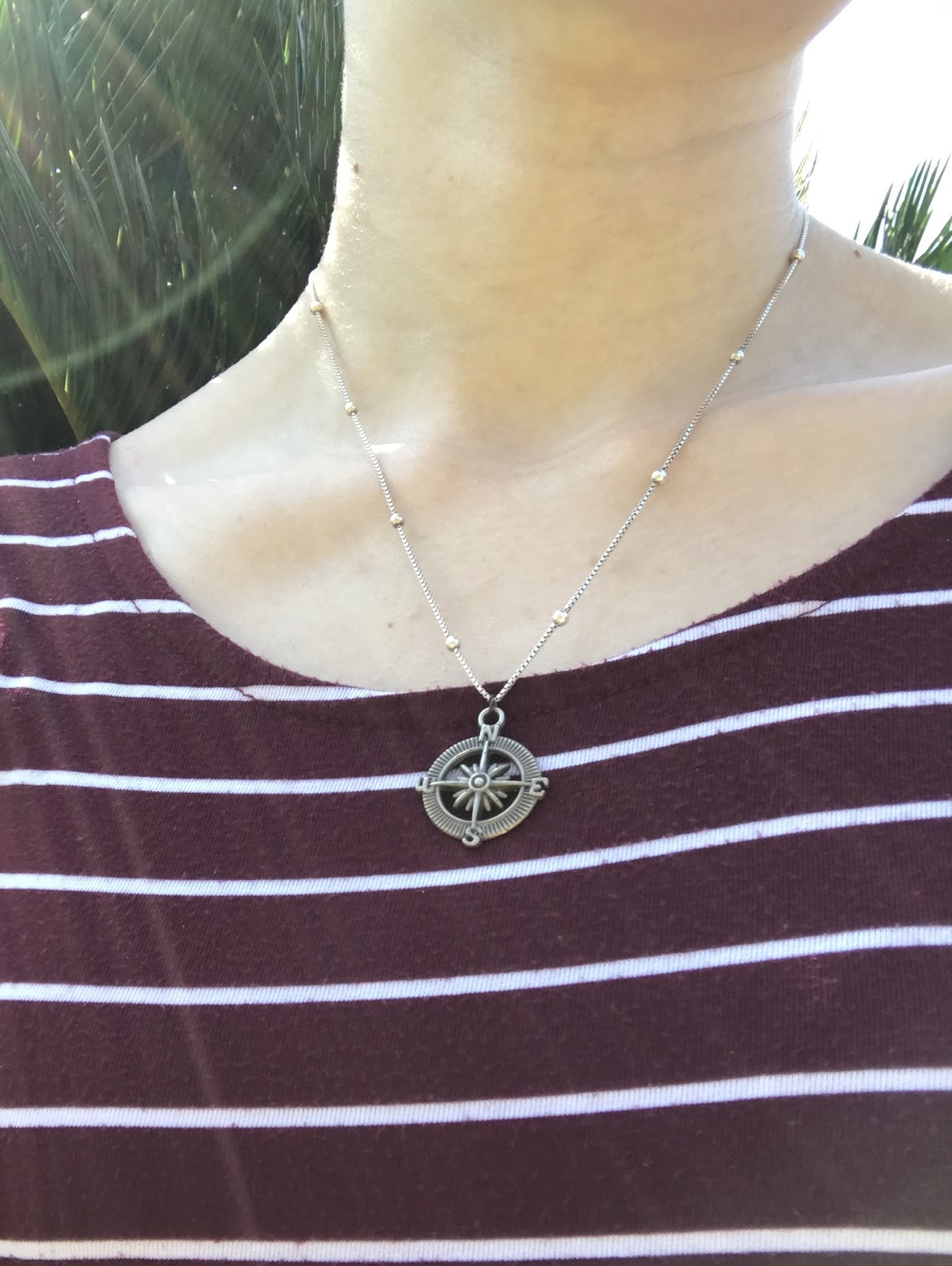
On the day I was baptized, I received a small compass pendant. I wore this necklace daily as a sign and symbol of the commitments I'd made, as a reminder of my responsibilities and, more importantly, God’s promises. In the book of 1 Nephi, Lehi and his family use the Liahona to know where to go. God gives the Liahona power to show Lehi where to go as he has faith and is obedient to the commandments, as he does what is right. My necklace reminded me of this Liahona, and reminded me that as I was faithful and trusting, I would be led to know what to do. I believed that God had led me thus far, and that God would continue to show me whither I should go.

Two years.

Two years of trusting that I would always be led, as long as I sought guidance and listened.

Well, most of two years. There was a period during this second year that I did not believe that I would could be led. I don't know why this happened. I don't know if I was led during this time. I can't explain all the feelings that I had during that time, or why I had them - anger, confusion, sadness, hopelessness, loneliness. But I know again that I am guided by a light which resides deep within me, which can be heard when I cultivate stillness and practice the discipline of simply being.

I find moments of happiness. I find moments of wholeness. I find pieces of a confident trust in a power beyond myself. I hope.

I am not the same girl I was on the day of my baptism. I am not the same kind of Mormon I was the day I was baptized. However, my name is on the books and I hold to a hope that there is a power within and beyond us which beckons us forward and will deign to reveal to us what we should do - a power many call “God.” A power which created our world and our lives and is deeply invested in the happenings of our existence. A being who longs to see all of creation, “all nations, kindreds, tongues, and people” liberated from sin and darkness and united in love for one another.

Because I hold to this hope, because I believe in a God who continually gives new information to humanity, because I want to be a part of a community who encourages questions and seeks to learn what God would have them learn, because I love the story of a small boy with big questions who was brave enough and confident enough to ask God what’s what - because of all these things, I'll keep the “Mormon” label. And I'll end this in a characteristically Mormon fashion - with a testimony.


Today, on this two-year anniversary, I believe two things.

  1. The day dawn is breaking.
  2. We’ll find the place which God for us prepared.

I have this hope as an anchor for my soul.